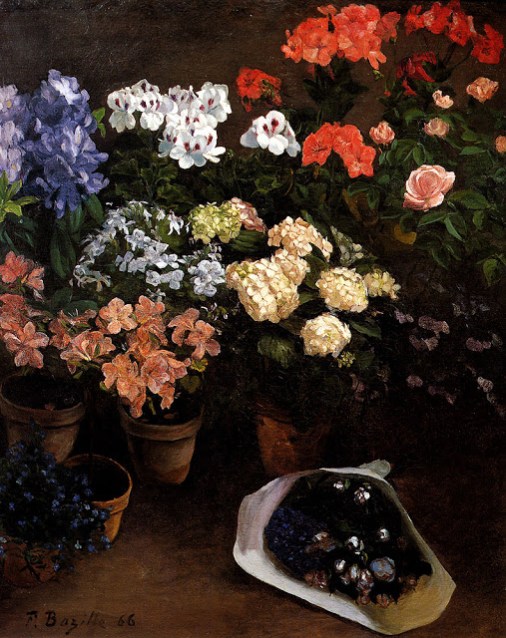
Frederic Bazille’s Etude de Fleurs of 1866 is among the most remarkable and beautiful still-life paintings in the history of the Impressionist movement. Painted in the greenhouse of his family’s property in Meric near Montpellier, the artist produced a painting that is more than a conventional still-life or nature morte. Instead of a formally arranged assemblage of objects, game, food, or cut flowers, the twenty-five-year-old artist focused on live flowers in terracotta pots on the floor of the greenhouse. While there is an evident debt to Gustave Courbet’s Realism and his interpretations of flower subjects, Bazille’s Etude de Fleurs is distinguished as a composition that breaks with the past. It moves beyond traditional ideas about symmetry, frontality, balance, and subject matter. The disposition of the flower pots seems entirely random and unplanned. It is free of the notions of order and compositional structure that were taught in art schools such as the Ecole des Beaux-Arts. Bazille, as well as Monet, Renoir, and Sisley, were fortunate to have been able to study painting in the studio of the academician Charles Gleyre. “Gleyre,” Rewald notes, “was a modest man, disliking to lecture, and all in all rather indulgent; he seldom took up a brush and corrected a student’s work. Renoir afterwards stated that Gleyre had been ‘of no help to his pupils,’ but added that he had the merit ‘of leaving them pretty much to their own devices.’ Gleyre did not even have preferences in subject matter and let his students paint what they wanted” (John Rewald, The History of Impressionism, New York, 1961, pp. 72-74).
“By the time Bazille began to paint [Etude de Fleurs] in 1866,” Tinterow continues, “he had the opportunity to study Monet’s Fleurs de printemps of 1864 and Renoir’s analogous Fleurs de PrintempsEtude de Fleurs] as a safe bet to the Salon of 1868, it was Manet who was cited as Bazille’s…example, since Monet and Renoir were still virtually unknown.” of 1864. He had also looked long and hard at Manet’s still lifes in the 1865 exhibition at the Galerie Martinet and at Cadart’s…When Bazille sent [
 tout ceci est magnifique