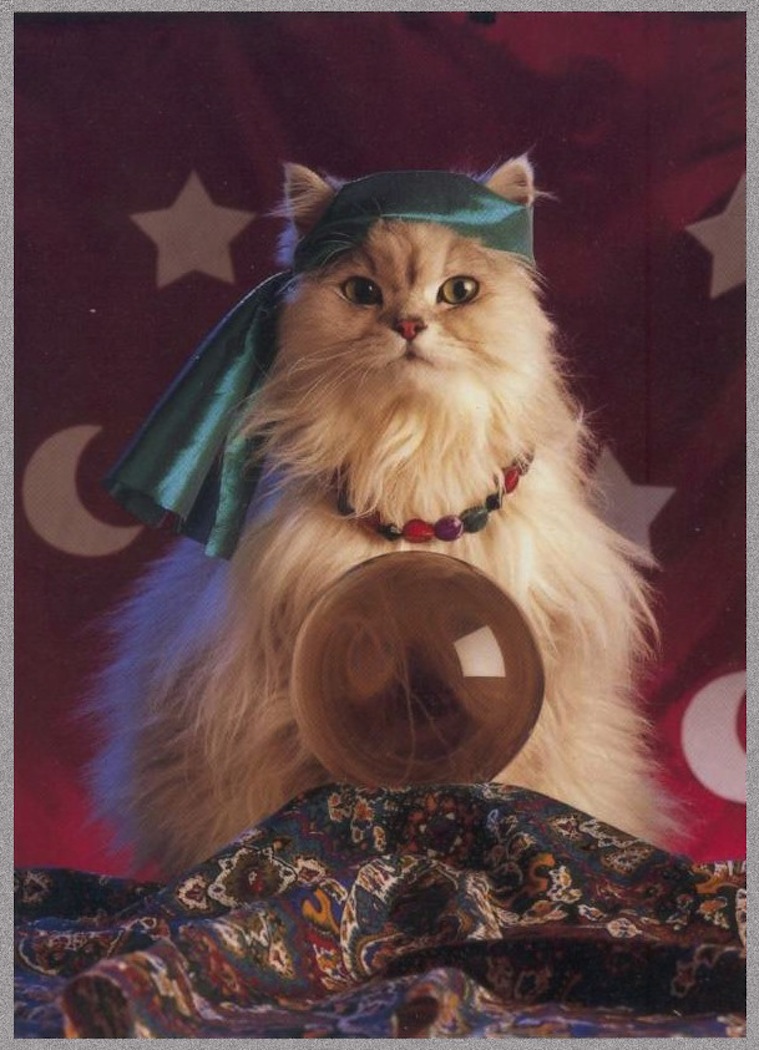
fortune-teller

If you have any questions to ask—ask them freely—and if it be in my power, I will answer without reserve—without reserve.
I asked a few questions of minor importance—paid her $2 and left—under the decided impression that going to the fortune-teller’s was just as good as going to the opera, and cost scarcely a trifle more—ergo, I will disguise myself and go again, one of these days, when other amusements fail. 
 
Mark Twain ~ Fragment of a letter to his brother Orion Clemens New Orleans, February 6, 1861 
[The clairvoyant of this visit was Madame Caprell, famous in her day.  Fee was $2; address, 37 Conti Street]

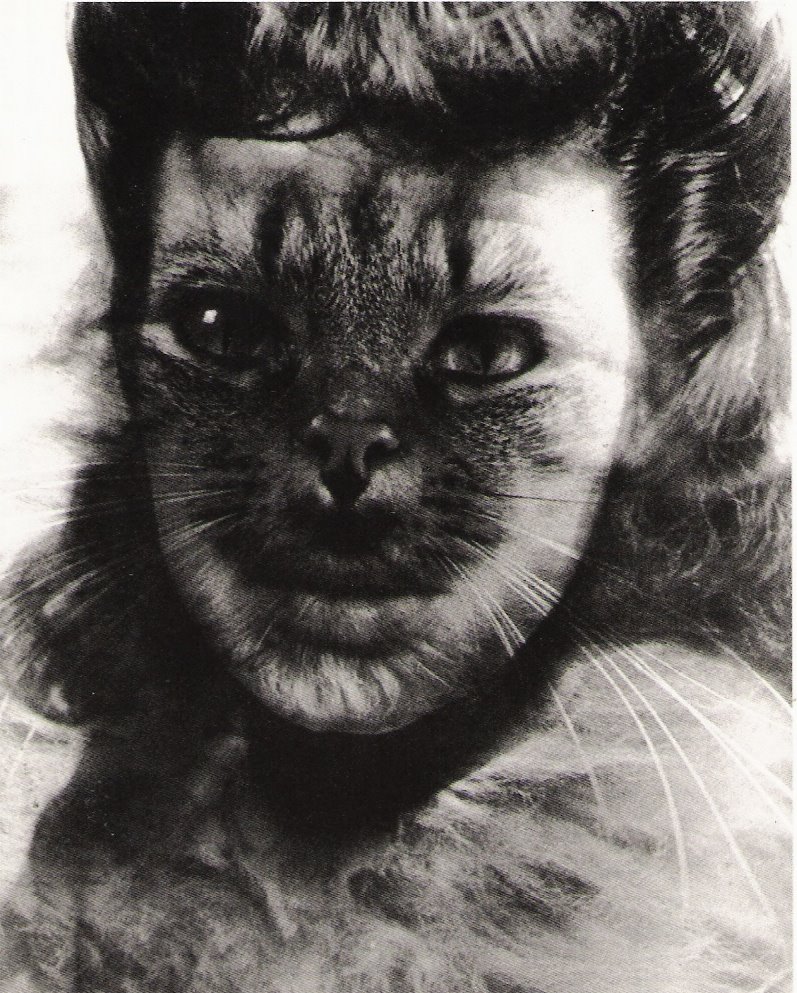
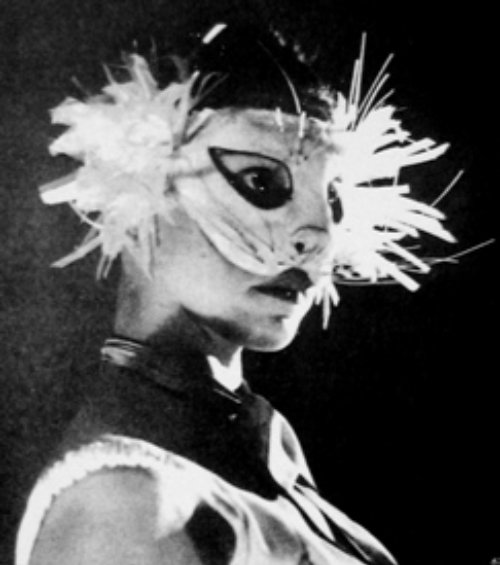
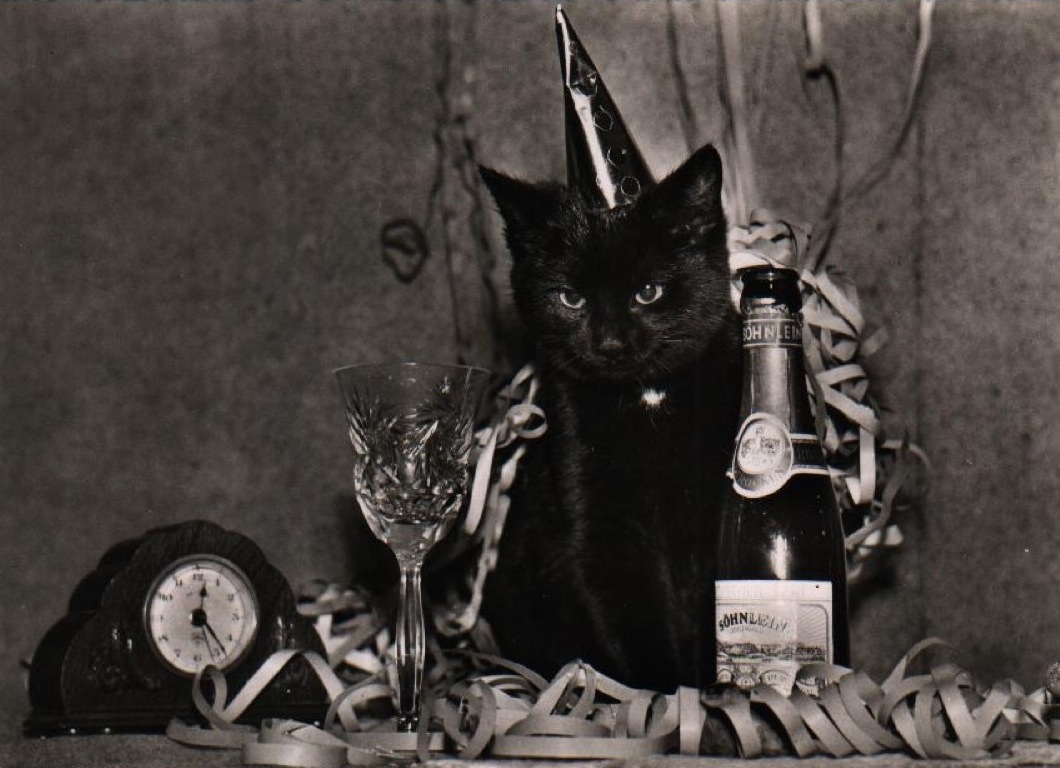
La Femme Chatte

 Max Albert Wyss, 1950

leaf.gif

Le Chat

Dans ma cervelle se promène
Ainsi qu’en son appartement,
Un beau chat, fort, doux et charmant,
Quand il miaule, on l’entend à peine,

Tant son timbre est tendre et discret;
Mais que sa voix s’apaise ou gronde,
Elle est toujours riche et profonde.
C’est là son charme et son secret.

Cette voix, qui perle et qui filtre
Dans mon fond le plus ténébreux,
Me remplit comme un vers nombreux
Et me réjouit comme un philtre.

Elle endort les plus cruels maux
Et contient toutes les extases;
Pour dire les plus longues phrases,
Elle n’a pas besoin de mots.

Non, il n’est pas d’archet qui morde
Sur mon cœur, parfait instrument,
Et fasse plus royalement
Chanter sa plus vibrante corde

Que ta voix, chat mystérieux,
Chat séraphique, chat étrange,
En qui tout est, comme un ange,
Aussi subtil qu’harmonieux.
Charles Baudelaire
Les Fleurs du Mal
 Gustave Courbet ~ Charles Baudelaire, 1848

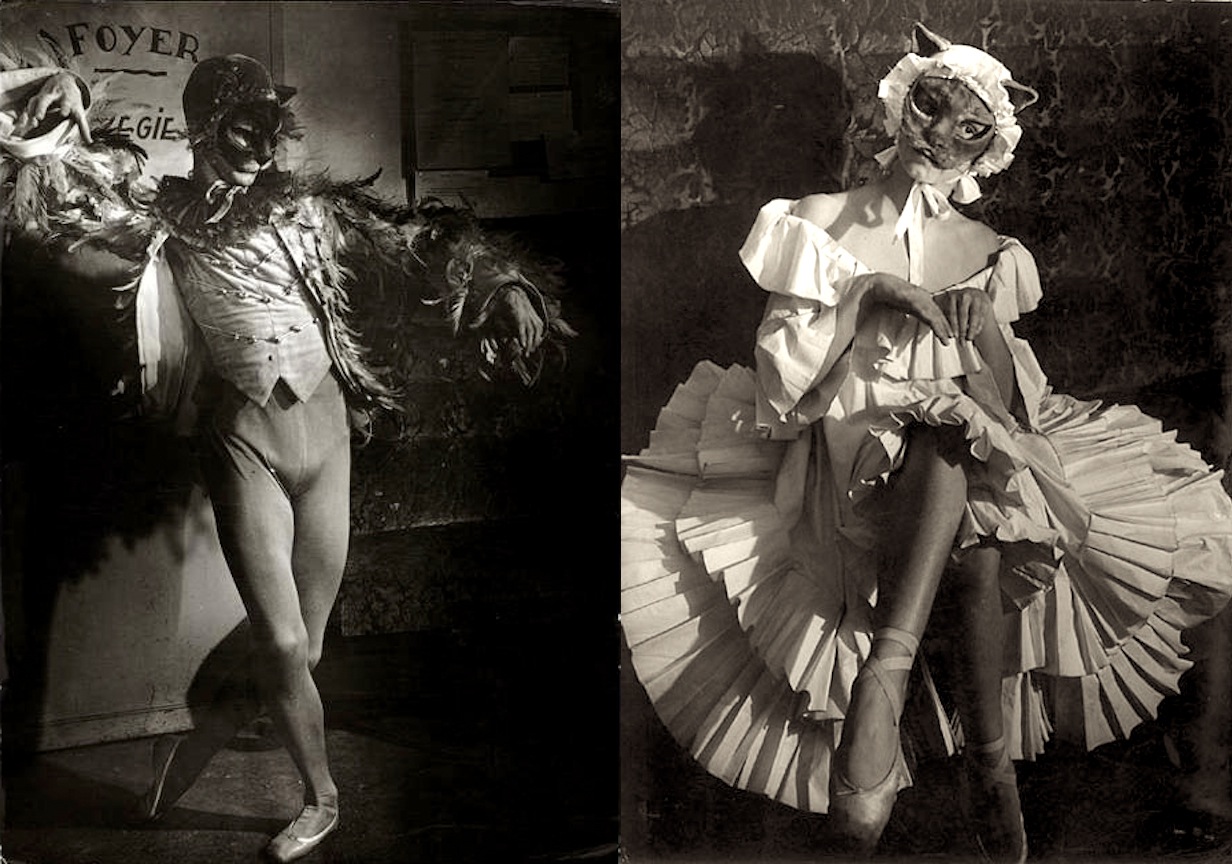
The Ladies of the Night

Brassaï ~ Dancers in Les Demoiselles de la Nuit, 1949
Les Demoiselles de la Nuit tells the story of a musician who falls in love with his beautiful cat Agathe, who has assumed semi-human form.  Agathe tries to be faithful to her human lover but is lured away by the sound of tomcats and the call of freedom.  She leaps off the rooftops and the musician falls to his death as he tries to grab hold of her.  She falls after him and they are united in death.
Agathe/Margot Fonteyn

World Premiere Les Ballets de Paris de Roland Petit, Theatre Marigny, Paris, May 21, 1948

Music by Jean Francaix 
Choreography by Roland Petit 
Libretto by Jean Anouilh 
Scenery and costumes by Leonor Fini 
Lighting by Peggy Clark 

Cast Margot Fonteyn, Roland Petit, Gordon Hamilton, Joan Sheldon


The White Cat

➔   La Chatte Blanche
Contes Nouveaux ou Les Fées à la Mode (New Tales, or Fairies in Fashion) 1698


❈ ❈ ❈ 
 Once upon a time there was a king who had three brave and handsome sons. He feared they might be seized with the desire of reigning before his death. Certain rumours were abroad that they were trying to gain adherents to assist them in depriving him of his kingdom. The king was old, but as vigorous in mind as ever, and had no desire to yield them a position he filled so worthily. He thought, therefore, the best way of living in peace was to divert them by promises he could always escape fulfilling… 
 ❈ ❈ ❈ 

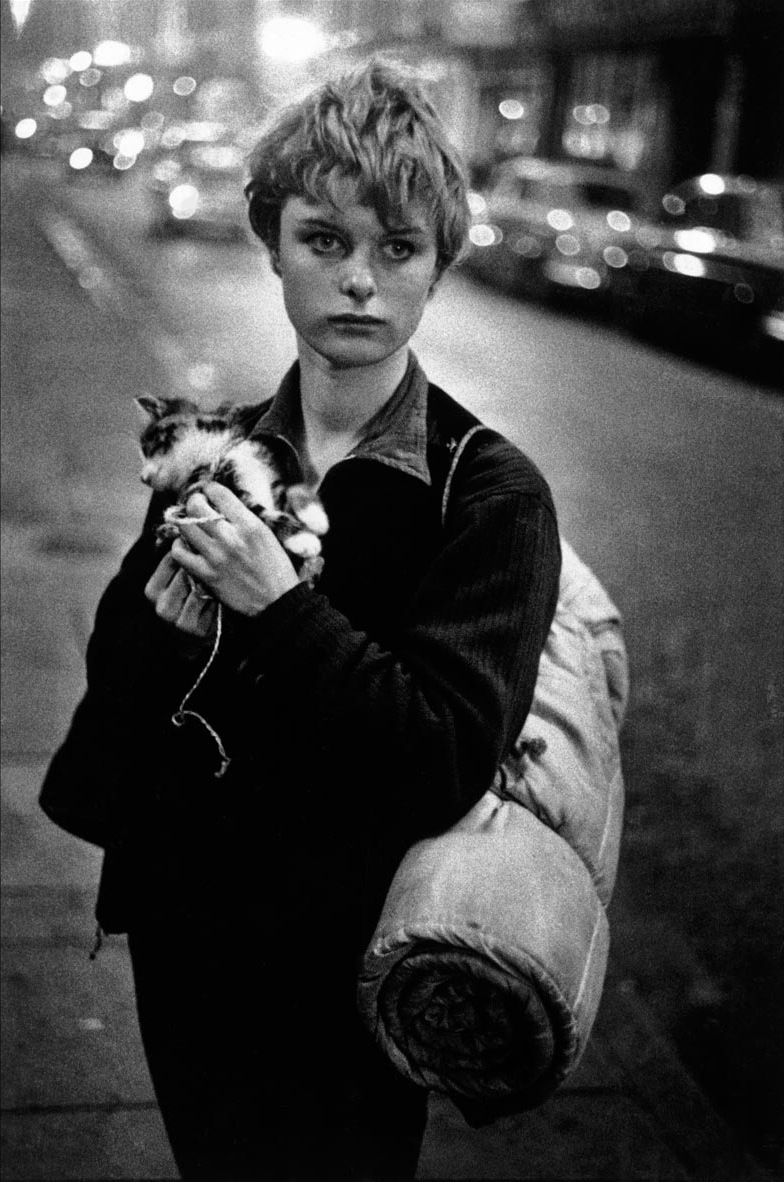
Girl with kitten

Bruce Davidson, London 1960

“I’m like Zsa Zsa Gabor,’’ Bruce Davidson says. “I’m famous, but no one knows for what.’’

Photography people know very well what Davidson is famous for. In a career that’s spanned more than half a century, he’s shot Marilyn Monroe and the civil rights movement, the building of the Verrazano-Narrows Bridge and the Supremes having a snowball fight. His photo essays on a Brooklyn youth gang in the ’50s, East Harlem in the ’60s, the New York subway system in the ’70s, and New York’s Central Park in the ’90s are classics.
A protege of Henri Cartier-Bresson and longtime member of the legendary agency Magnum Photos, Davidson was the first photographer to win a fellowship from the National Endowment for the Arts. Along with such contemporaries as Diane Arbus and Lee Friedlander, he helped transform documentary photography in the ’60s.
Davidson, 77, laughs when he recalls going to a burlesque show in Atlantic City with Arbus. Rumpled, relaxed, a little roly-poly, he’s Daddy Warbucks bald beneath a baseball cap and as amiable as Annie. He recalls Arbus saying, “You know, Bruce, you’re better when people are not looking at the camera, and I’m better when people are looking at the camera.’’

© 2010 The New York Times Company