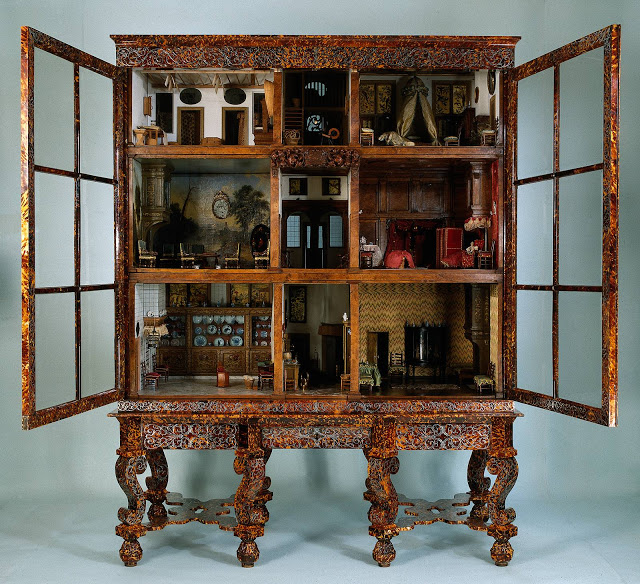
In 1686 Petronella Oortman, a widow and wealthy in her own right, married the silk merchant Johannes Brandt (1654-1731). The couple lived on Warmoesstraat in Amsterdam. That same year, Petronella Oortman began her magnificent doll’s house. She spent the following four years collecting miniature objects and furniture for the house, spending an estimated 20,000 to 30,000 guilders, the price of a real house along one of Amsterdam’s canals at that time.
 |
| ca. 1686-1705 |
[Hobbies: In the 17th century, many wealthy Dutch merchants had collections of one sort or another, which they kept in display cabinets. The wives of these well-to-do gentlemen also had collections, which reflected their personal interests: their homes. Some had large cupboards full of miniature furniture and dolls, replicas of a real home. These doll’s houses were sometimes on a magnificent scale. Whenever an important visitor dropped by, the host and hostess would show their collections. The master of the house would open the drawers of his cabinet and explain the contents to his guests, while his wife gave a comprehensive demonstration of her doll’s house. She would display the contents of the cupboards, reveal hidden spaces, light the lamps and would let real water gush from the fountain in the garden. Doll’s house demonstrations sometimes went on for hours.] Rijksmuseum Amsterdam
 tout ceci est magnifique