
“There is a certain age when a woman must be beautiful to be loved, and then there comes a time when she must be loved to be beautiful.” –Françoise Sagan
“There is no progress in art, any more than there is progress in making love. There are simply different ways of doing it.” Man Ray

Devant la blanche ferme où parfois vers midi
Un vieillard vient s'asseoir sur le seuil attiédi,
Où cent poules gaîment mêlent leurs crêtes rouges,
Où, gardiens du sommeil, les dogues dans leurs bouges
Ecoutent les chansons du gardien du réveil,
Du beau coq vernissé qui reluit au soleil,
Une vache était là, tout à l'heure arrêtée.
Superbe, énorme, rousse et de blanc tachetée,
Douce comme une biche avec ses jeunes faons,
Elle avait sous le ventre un beau groupe d'enfants,
D'enfants aux dents de marbre, aux cheveux en broussailles
Frais, et plus charbonnés que de vieilles murailles,
Qui, bruyants, tous ensemble, à grands cris appelant
D'autres qui, tout petits, se hâtaient en tremblant,
Dérobant sans pitié quelque laitière absente,
Sous leur bouche joyeuse et peut-être blessante
Et sous leurs doigts pressant le lait pas mille trous,
Tiraient le pis fécond de la mère au poil roux.
Elle, bonne et puissante et de son trésor pleine,
Sous leurs mains par moments faisant frémir à peine
Son beau flanc plus ombré qu'un flanc de léopard,
Distraite, regardait vaguement quelque part.

Ainsi, Nature ! abri de toute créature !
O mère universelle ! indulgente Nature !
Ainsi, tous à la fois, mystiques et charnels,
Cherchant l'ombre et le lait sous tes flancs éternels,
Nous sommes là, savants, poëtes, pêle-mêle,
Pendus de toutes parts à ta forte mamelle !
Et tandis qu'affamés, avec des cris vainqueurs,
A tes sources sans fin désaltérant nos cœurs,
Pour en faire plus tard notre sang et nos âme,
Nous aspirons à flots ta lumière et ta flamme,
Les feuillages, les monts, les prés verts, le ciel bleu,
Toi, sans te déranger, tu rêves à ton Dieu !

15 mai 1837
Victor Hugo ~ Les Voix intérieures

Macavity, Macavity, there’s no one like Macavity,
He’s broken every human law, he breaks the law of gravity.
His powers of levitation would make a fakir stare,
And when you reach the scene of crime – Macavity’s not there!
You may seek him in the basement, you may look up in the air –
But I tell you once and once again, Macavity’s not there!
Mcavity’s a ginger cat, he’s very tall and thin;
You would know him if you saw him, for his eyes are sunken in.
His brow is deeply lined with thought, his head is highly domed;
His coat is dusty from neglect, his whiskers are uncombed.
He sways his head from side to side, with movements like a snake;
And when you think he’s half asleep, he’s always wide awake.
Macavity, Macavity, there’s no one like Macavity,
For he’s a fiend in feline shape, a monster of depravity.
You may meet him in a by-street, you may see him in the square –
But when a crime’s discovered, then Macavity’s not there!
He’s outwardly respectable. (They say he cheats at cards.)
And his footprints are not found in any file of Scotland Yard’s.
And when the larder’s looted, or the jewel-case is rifled,
Or when the milk is missing, or another Peke’s been stifled,
Or the greenhouse glass is broken, and the trellis past repair –
Ay, there’s the wonder of the thing! Macavity’s not there!
And when the Foreign Office find a Treaty’s gone astray,
Or the Admiralty lose some plans and drawings by the way,
There may be a scrap of paper in the hall or on the stair –
But it’s useless to investigate – Mcavity’s not there!
And when the loss has been disclosed, the Secret Service say:
`It must have been Macavity!’ – but he’s a mile away.
You’ll be sure to find him resting, or a-licking of his thumbs,
Or engaged in doing complicated long-division sums.
Macavity, Macavity, there’s no one like Macavity,
There never was a Cat of such deceitfulness and suavity.
He always has an alibi, and one or two to spaer:
At whatever time the deed took place – MACAVITY WASN’T THERE!
And they say that all the Cats whose wicked deeds are widely known
(I might mention Mungojerrie, I might mention Griddlebone)
Are nothing more than agents for the Cat who all the time
Just controls their operations: the Napoleon of Crime!
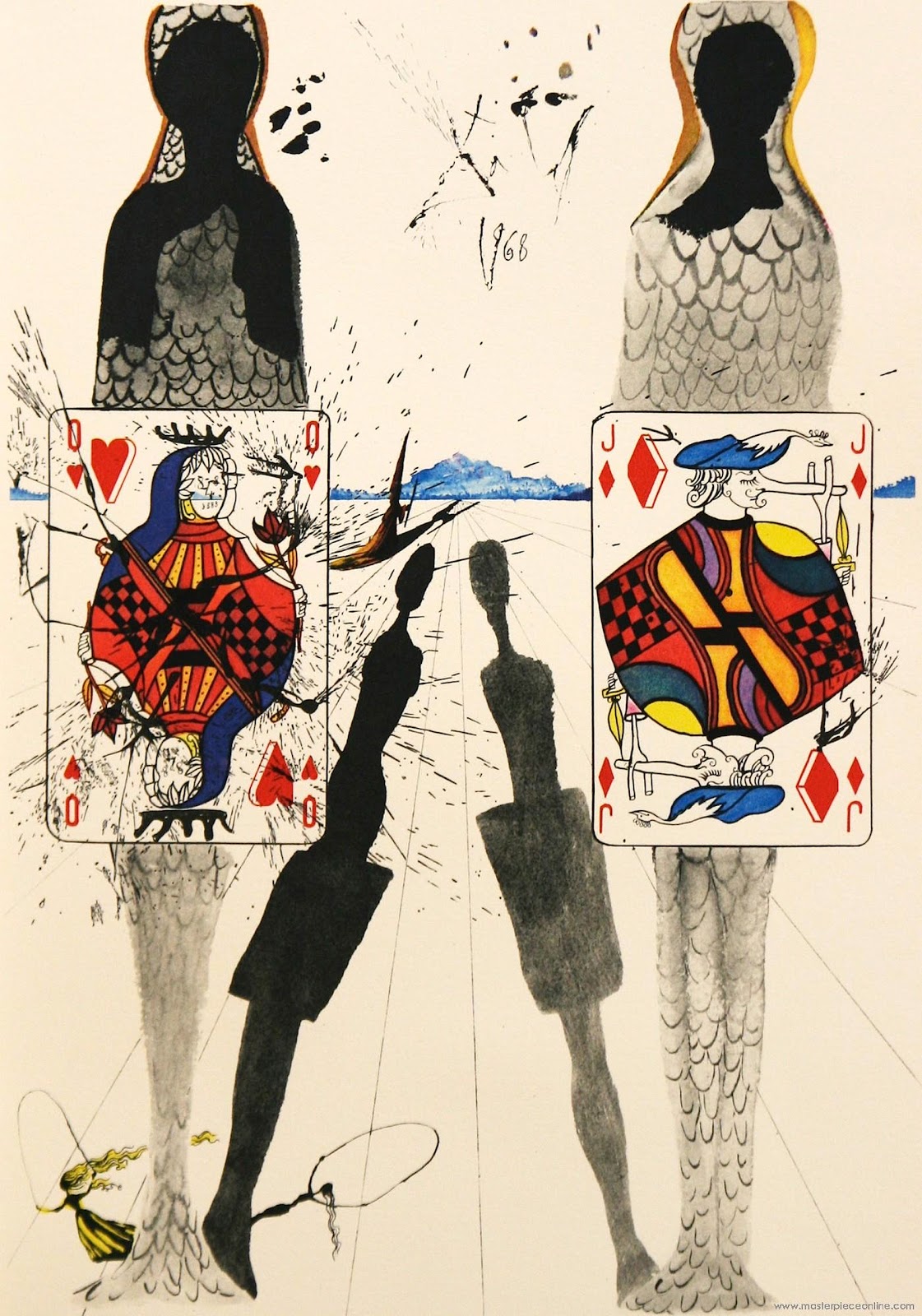

How did you come to start Bonjour tristesse when you were eighteen? Did you expect it would be published?
I simply started it. I had a strong desire to write and some free time. I said to myself, This is the sort of enterprise very, very few girls of my age devote themselves to; I’ll never be able to finish it. I wasn’t thinking about “literature” and literary problems, but about myself and whether I had the necessary willpower.
Did you let it drop and then take it up again?
No, I wanted passionately to finish it—I’ve never wanted anything so much. While I was writing I thought there might be a chance of its being published. Finally, when it was done, I thought it was hopeless. I was surprised by the book and by myself.
Had you wanted to write for a long time before?
Yes. I had read a lot of stories. It seemed to me impossible not to want to write one. Instead of leaving for Chile with a band of gangsters, one stays in Paris and writes a novel. That seems to me the great adventure.
How quickly did it go? Had you thought out the story in advance?
For Bonjour tristesse all I started with was the idea of a character, the girl, but nothing really came of it until my pen was in hand. I have to start to write to have ideas. I wrote Bonjour tristesse in two or three months, working two or three hours a day. Un Certain sourire was different. I made a number of little notes and then thought about the book for two years. When I started in writing, again two hours a day, it went very fast. When you make a decision to write according to a set schedule and really stick to it, you find yourself writing very fast. At least I do.
Do you spend much time revising the style?
Then the work on the two novels didn’t take more than five or six months in all?
Yes, it’s a good way to make a living.
You say the important thing at the start is a character?
A character, or a few characters, and perhaps an idea for a few of the scenes up to the middle of the book, but it all changes in the writing. For me writing is a question of finding a certain rhythm. I compare it to the rhythms of jazz. Much of the time life is a sort of rhythmic progression of three characters. If one tells oneself that life is like that, one feels it less arbitrary.
Do you draw on the people you know for your characters?
I’ve tried very hard and I’ve never found any resemblance between the people I know and the people in my novels. I don’t search for exactitude in portraying people. I try to give to imaginary people a kind of veracity. It would bore me to death to put into my novels the people I know. It seems to me that there are two kinds of trickery: the “fronts” people assume before one another’s eyes, and the “front” a writer puts on the face of reality.
Then you think it is a form of cheating to take directly from reality?
Certainly. Art must take reality by surprise. It takes those moments which are for us merely a moment, plus a moment, plus another moment, and arbitrarily transforms them into a special series of moments held together by a major emotion. Art should not, it seems to me, pose the “real” as a preoccupation. Nothing is more unreal than certain so-called “realist” novels—they’re nightmares. It is possible to achieve in a novel a certain sensory truth—the true feeling of a character—that is all.
Of course the illusion of art is to make one believe that great literature is very close to life, but exactly the opposite is true. Life is amorphous, literature is formal.
There are certain activities in life with highly developed forms, for instance, horse racing. Are the jockeys less real because of that?
People possessed by strong passions for their activities, as jockeys may seem to be, don’t give me the impression of being very real. They often seem like characters in novels, but without novels, like The Flying Dutchman.
Do your characters stay in your mind after the book is finished? What kind of judgments do you make about them?
When the book is finished I immediately lose interest in the characters. And I never make moral judgments. All I would say is that a person was droll, or gay, or, above all, a bore. Making judgments for or against my characters bores me enormously; it doesn’t interest me at all. The only morality for a novelist is the morality of his esthétique. I write the books, they come to an end, and that’s all that concerns me.
When you finished Bonjour tristesse did it undergo much revising by an editor?
A number of general suggestions were made about the first book. For example, there were several versions of the ending and in one of them Anne didn’t die. Finally it was decided that the book would be stronger in the version in which she did.
Did you learn anything from the published criticism of the book?
When the articles were agreeable I read them through. I never learned anything at all from them but I was astonished by their imagination and fecundity. They saw intentions I never had.
I like Un Certain sourire better, because it was more difficult. But I find Bonjour tristesse amusing because it recalls a certain stage of my life. And I wouldn’t change a word. What’s done is done.
Why do you say Un Certain sourire is a more difficult book?
I didn’t hold the same trump cards in writing the second book: no seaside summer-vacation atmosphere, no intrigue naively mounting to a climax, none of the gay cynicism of Cécile. And then it was difficult simply because it was the second book.
Did you find it difficult to switch from the first person of Bonjour tristesse to the third-person narrative of Un Certain sourire?
Yes, it is harder, more limiting and disciplining. But I wouldn’t make as much of that difficulty as some writers apparently do.
What French writers do you admire and feel are important to you?
Oh, I don’t know. Certainly Stendhal and Proust. I love their mastery of the narrative, and in some ways I find myself in definite need of them. For example, after Proust there are certain things that simply cannot be done again. He marks off for you the boundaries of your talent. He shows you the possibilities that lie in the treatment of character.
What strikes you particularly about Proust’s characters?
Perhaps the things that one does not know about them as much as the things one knows. For me, that is literature in the very best sense: after all the long and slow analyses one is far from knowing all the thoughts and facts and sides of Swann, for example—and that is as it should be. One has no desire at all to ask “Who was Swann?” To know who Proust was is quite enough. I don’t know if that’s clear: I mean to say that Swann belongs completely to Proust and it is impossible to imagine a Balzacian Swann, while one might well imagine a Proustian Marsay.
Is it possible that novels get written because the novelist imagines himself in the role of a novelist writing a novel?
No, one assumes the role of hero and then seeks out “the novelist” who can write his story.
And one always finds the same novelist?
Essentially, yes. Very broadly, I think one writes and rewrites the same book. I lead a character from book to book, I continue along with the same ideas. Only the angle of vision, the method, the lighting, change. Speaking very, very roughly, it seems to me there are two kinds of novels—there is that much choice. There are those which simply tell a story and sacrifice a great deal to the telling—like the books of Benjamin Constant, which Bonjour tristesse and Un Certain sourire resemble in construction. And then there are those books which attempt to discuss and probe the characters and events in the book—un roman où l’on discute. The pitfalls of both are obvious: in the simple narrative it often seems that the important questions are passed over. In the longer classical novel the digressions can impair the effectiveness.
Yes, I would like to write—in fact I’m now planning—a novel with a larger cast of characters—there will be three heroines—and with characters more diffuse and elastic than Dominique and Cécile and the others in the first two books. The novel I would like to write is one in which the hero would be freed from the demands of the plot, freed from the novel itself and from the author.
To what extent do you recognize your limits and maintain a check on your ambitions?
Well, that is a pretty disagreeable question, isn’t it? I recognize limitations in the sense that I’ve read Tolstoy and Dostoyevsky and Shakespeare. That’s the best answer, I think. Aside from that I don’t think of limiting myself.
You’ve very quickly made a lot of money. Has it changed your life? Do you make a distinction between writing novels for money and writing seriously, as some American and French writers do?
Of course the success of the books has changed my life somewhat because I have a lot of money to spend if I wish, but as far as my position in life is concerned, it hasn’t changed much. Now I have a car but I’ve always eaten steaks. You know, to have a lot of money in one’s pocket is nice, but that’s all. The prospect of making more or less money would never affect the way I write—I write the books, and if money appears afterward, tant mieux.
Mlle. Sagan interrupted the interviewer to say that she had to leave to work on a radio program. She apologized and got up to go. It was difficult to believe, once she had stopped talking, that the slight, engaging girl had, with a single book, reached more readers than most novelists do in a lifetime. Rather, one would have thought her a schoolgirl rushing off to the Sorbonne as she called down the apartment hall to her mother, “Au revoir, maman. Je sors travailler mais je rentre de bonne heure.”


1814, en France, sur un champ de bataille. Parmi les cadavres, un blessé hurle de douleur. C’est Roger de Tinchebraye, grièvement touché au visage. Secouru à temps et soigné par le docteur Marchal, le gentilhomme est bientôt guéri. Mais celui dont le charme, avant la guerre, chavirait tous les cœurs, devra désormais porter un masque, sorte de nez de cuir dont les jaloux lui feront un sobriquet, convaincus que ce ” Don Juan sans nez ” laissera désormais leurs femmes tranquilles.
Or, ” Nez de Cuir” n’a rien perdu de sa séduction. Bien plus, le voilà maintenant auréolé d’un mystère qui en accroît encore le pouvoir. Et pour se prouver qu’il n’est en rien diminué, Roger multiplie les liaisons, prenant et abandonnant ses victimes avec le plus parfait cynisme.
Parmi celles-ci, Hélène Josias qu’il reçoit comme les autres, dans son pavillon de chasse. Une nuit la nièce d’Hélène, la jeune Judith de Rieusses, vient y chercher sa tante. Elle ne peut échapper au charme de Roger, mais son innocence lui fait rêver d’un mariage dont elle parle, naïvement, au séducteur.
Celui-ci, touché, écarte brutalement cette éventualité : jamais il ne pourra être fidèle à une femme.
Judith épouse alors, le marquis de Brives, un homme plus âgé qu’elle dont Roger devient, pour rester près de la jeune femme, le confident et l’ami.
Après la mort du marquis, Nez de Cuir ne doute plus de son amour pour Judith à qui, un soir, il exprime sa passion avec violence. Bien qu’émue, Judith le repousse, lui reprochant de la traiter comme les autres, d’être un monstre.
Se méprenant sur ce terme, par dépit autant que par défi, Roger arrache alors son masque. Il lit dans les yeux de sa bien-aimée le seul sentiment qu’il ne puisse supporter : la pitié. Une pitié qui, en lui faisant prendre conscience de sa déchéance, sonnera le glas de sa carrière de séducteur.



 tout ceci est magnifique