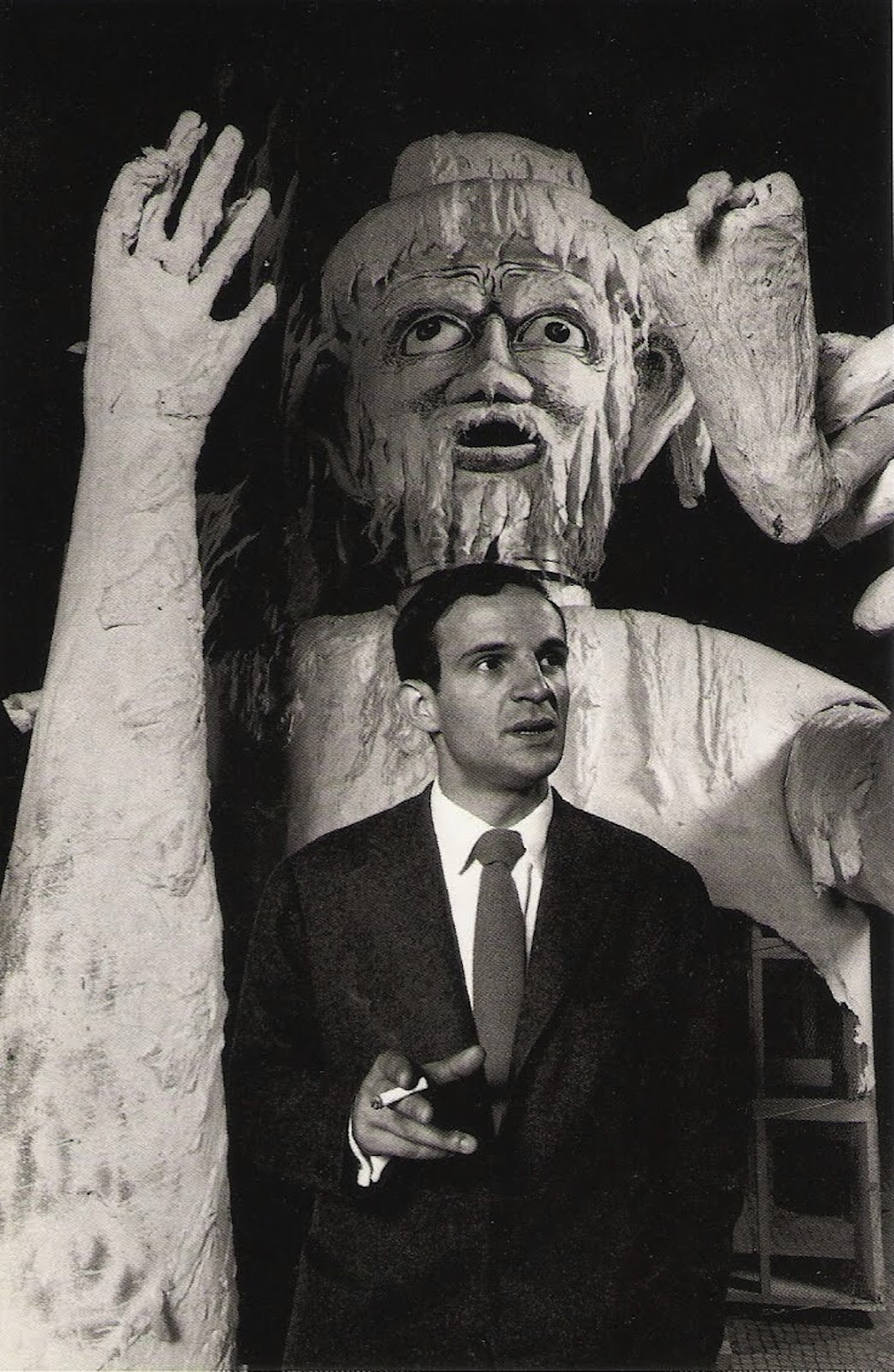
Henri Dauman ~ François Truffaut at “Exposition commémorative du centenaire de Georges Méliès” at the Palais du Louvre, Paris 1961
Category: Louvre
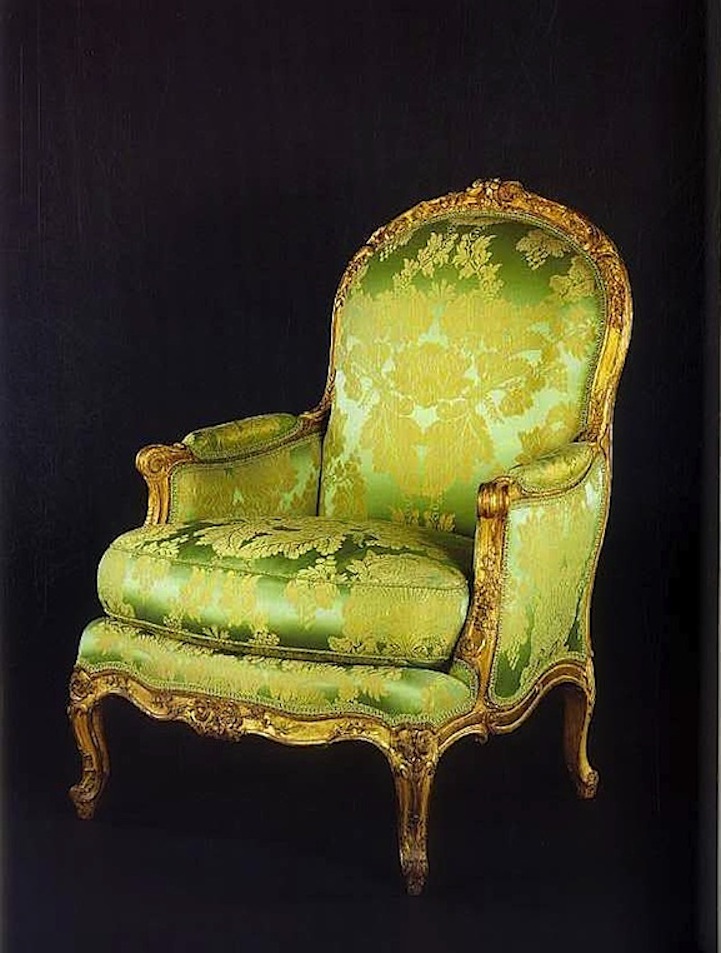
Bergère à la Reine
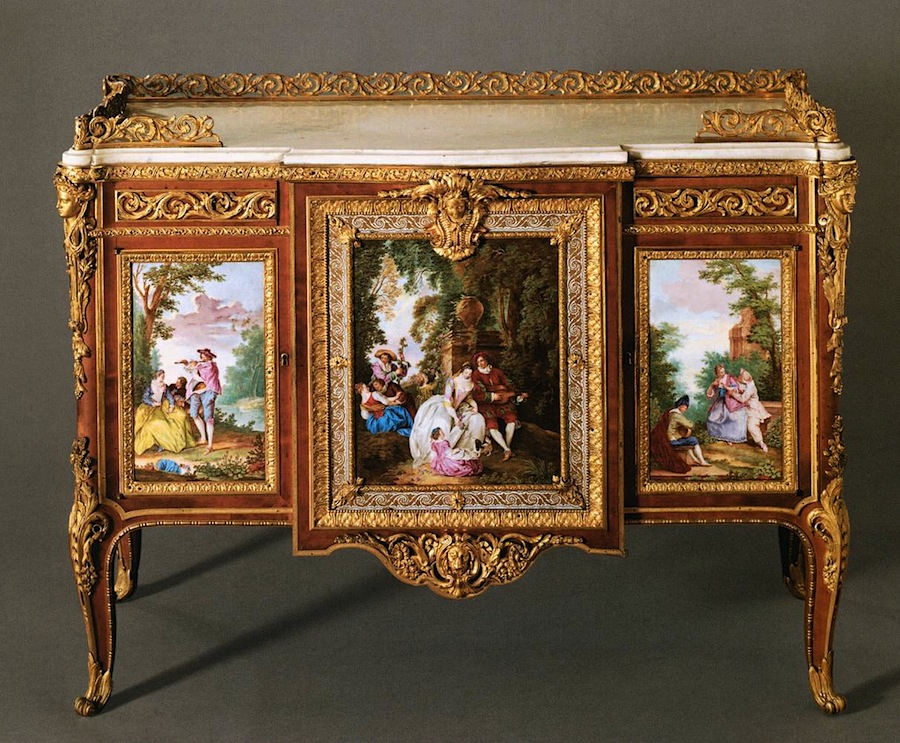
La commode de Mme. du Barry
Attributed to Martin Carlin, 1772 [Musee du Louvre, Paris]
Left plaque: after Nicolas Lancret ~ Par une Tendre Chansonnette
Center plaque: after Jean-Baptiste Pater ~ L’Agréable Société
Right plaque: after Nicolas Lancret ~ La Conversation Gallante
The apartments of the favorite at Versailles formed a series of boudoirs, each of which seemed to those who entered for the first time more elegant than another. The chimney-piece in the salon was adorned with a magnificent clock, “around which a world of porcelain figures disported themselves.” In the same room were two commodes of priceless lacquer, one relieved by figures in gold, the other decorated with fine porcelain plaques, which, we are told, had not their equals in Europe. From the ceiling hung a lustre of rock-crystal, which had cost 16,000 livres, and in a a corner stood a beautiful piano, the work of the famous Clicot, the case of which was of rosewood, exquisitely inlaid and lavishly gilded. The cabinet contained a writing-table plated with porcelain, and an inkstand which was a masterpiece of the goldsmith’s art; while in the bedroom was a wonderful clock, which represented ” the Three Graces supporting the vase of Time,” and Love indicating the hour with his arrow. “The most exquisite objects of art, marvels of upholstery, bronzes, marbles, statuettes, abounded in this asylum of voluptuous pleasure. It was the last word of luxury.”! – Hugh Noel Williams Memoirs of Madame Du Barry, of the court of Louis XV, 1910
Rococo
![]() |
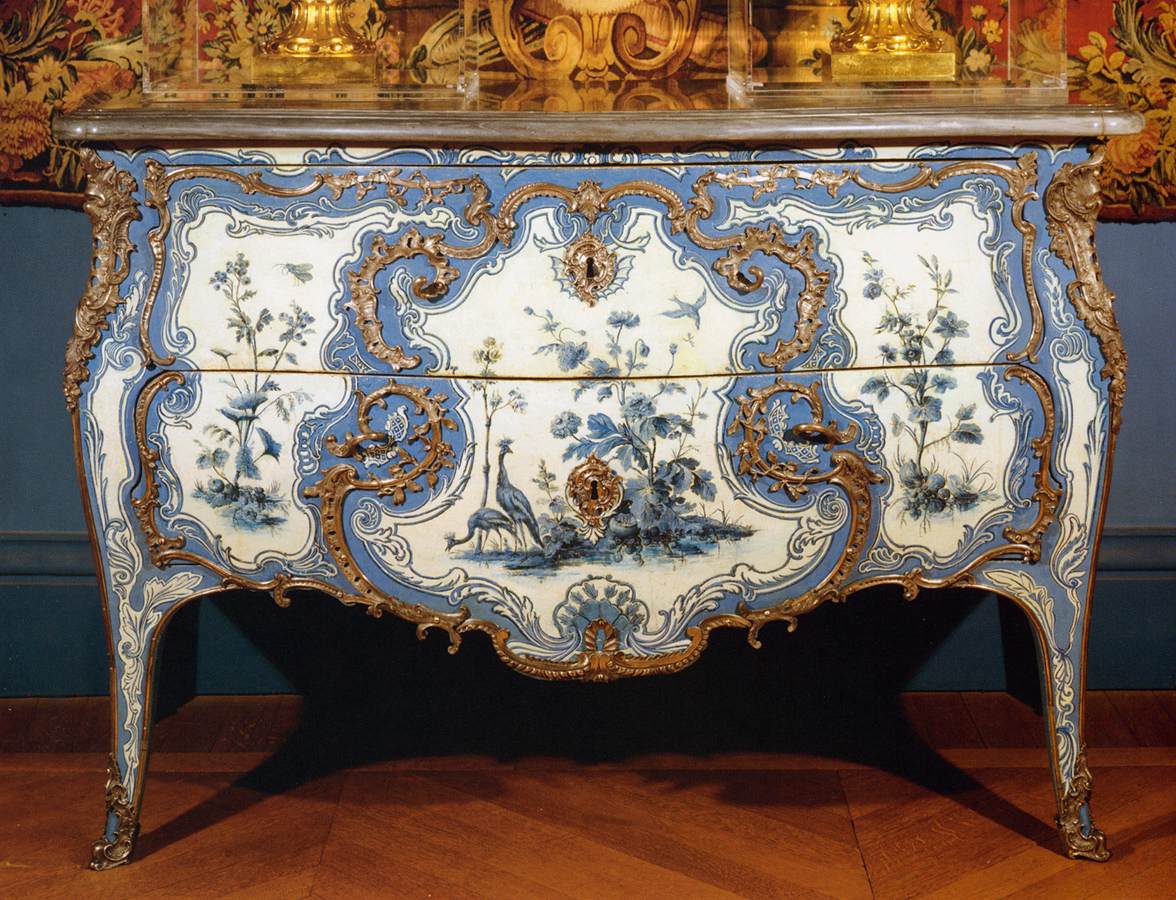
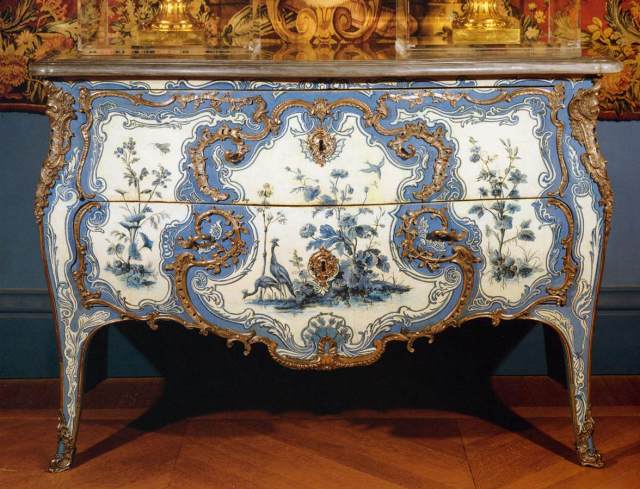
| Estampillée : Matthieu Criaerd, 1742 Commode Painted in Vernis Martin, Wood, 85 x 132 x 64 Wood, 85 x 132 x 64 Musée du Louvre, Paris |
Commode
Louis XV acquired the Château de Choisy in 1739. The furniture in the Blue Room (commissioned from the marchand mercier Hébert) was designed to match some blue silk woven by the king’s mistress, Madame de Mailly, and to suit her taste for oriental art. Hébert had the commode and encoignure (corner cabinet) for the room made by cabinetmaker Matthieu Criaerd. The commode is a fine example of Criaerd’s work.
The Blue Room at the Château de Choisy
Madame de Mailly’s room was elaborately furnished in 1742. Louis XV’s mistress had given the king some silk that she had woven; this was made into blue and white striped moiré, and was used in the room which was then painted blue and white. The marchand mercier Hébert and the upholsterer Sallior were given the task of producing the furniture, which was to suit both the colors of the silk and Madame de Mailly’s taste for chinoiserie.
The production of the furniture
Although the marchand mercier Hébert was entrusted with producing the furniture, a commode veneered with Chinese lacquer was first delivered by his colleague Julliot. Hébert therefore made furniture to match this commode — provisional items, no doubt, which were subsequently replaced by the blue and white furniture which confirms Madame de Mailly’s pronounced taste for objects of oriental inspiration, reflected throughout her decorative scheme. Hébert provided blue and white China porcelain for the same apartment, together with silver-plated andirons decorated with figures of Chinese children. Hébert entrusted the production of the blue furniture to cabinetmaker Mattheu Criaerd.
A commode typical of Criaerd’s work
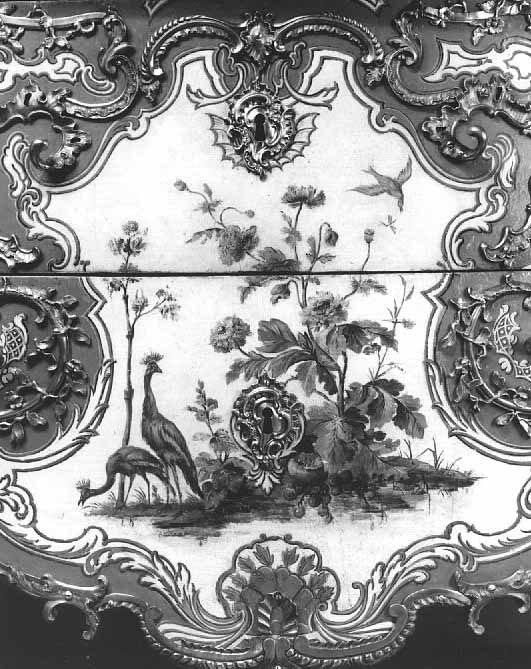
Matthieu Criaerd produced a commode and encoignure (corner cabinet) which are now in the Louvre. The commode, with its curved legs and two long drawers, resembles the one delivered to Fontainebleau for Queen Maria Leczinska by BVRB in 1737. It is coated with blue and white vernis Martin, essentially representing exotic birds and plants, freely inspired by Chinese motifs. The silvered bronze decoration, typical of Criaerd, consists of trophies down the sides of the legs, and pierced sabots. The frames are formed by a series of scrolls, and the central, violin-shaped cartouche is created by a wavy border pierced with ovals, scrolls, and foliage. This type of decoration became very popular; it features on other commodes by Criaerd, notably the one in the former Grog-Carven Collection, or the one delivered by Hébert for the Dauphin’s study at the Château de Versailles in 1748.
Catalogue d’exposition : « Nouvelles acquisitions du département des Objets d’art 1990-1994 », Paris, 1995, pp. 31, 134-136.
D. Alcouffe, A. Dion-Tenenbaum, A. Lefébure, Le Mobilier du Musée du Louvre, t. 1, Paris, Faton, 1993, pp. 144-147
Louvre
Louvre