 |
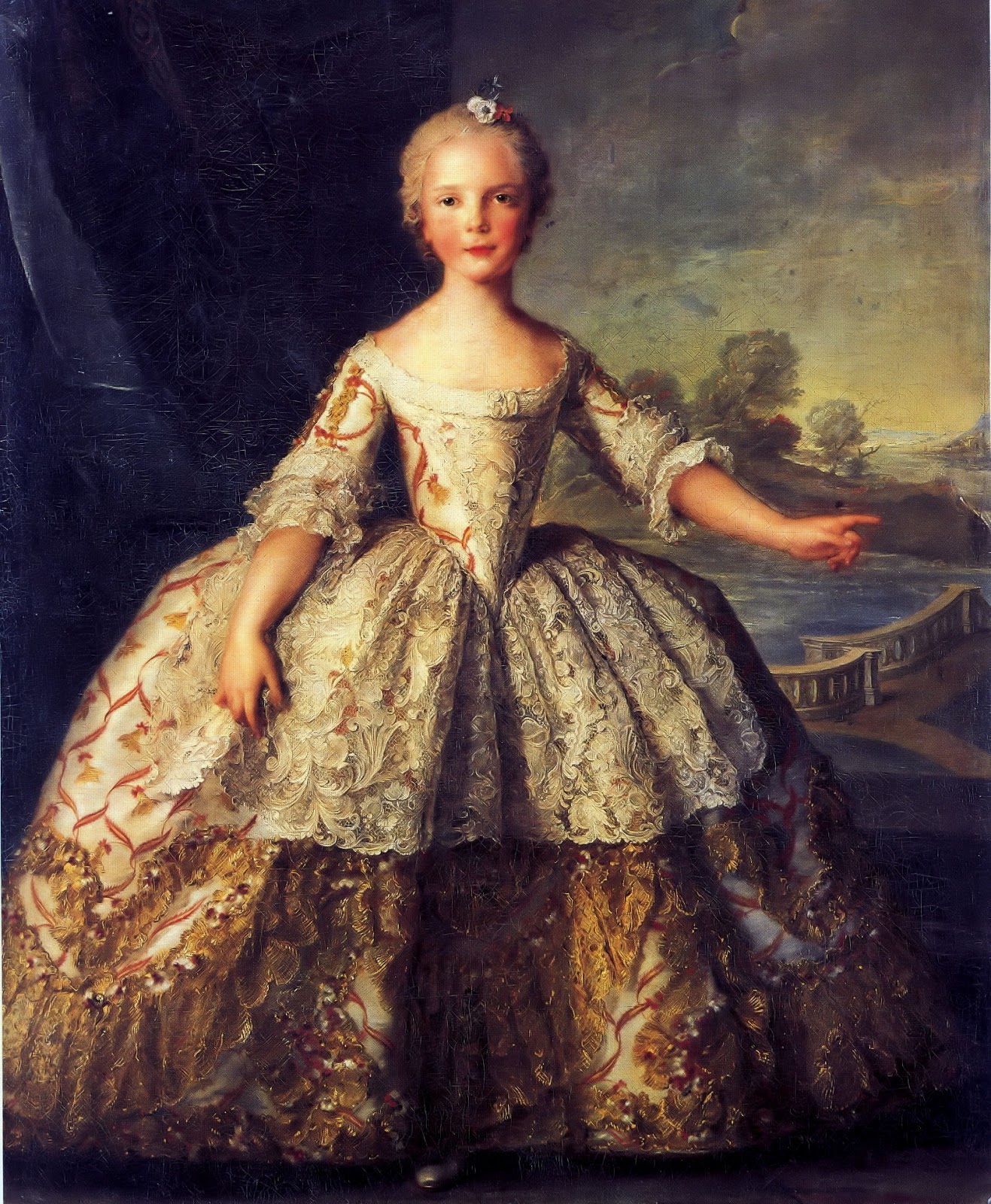
| Jean-Marc Nattier ~ Princess Maria Isabella of Parma, Infanta of Spain, 1749
• • • • •
A most interesting Habsburg story, which has never been published, concerns Maria-Theresa’s son, the Emperor Joseph II., who married Isabella, daughter of Ferdinand, Duke of Parma —one of the Spanish Bourbons—and if I may here digress, I should like to tell it.
Isabella was a lovely girl, and her ambitious mother, a daughter of Louis XV. of France, naturally wished her to make a brilliant marriage. The gratification of the Duke and Duchess of Parma was extreme when the Emperor Joseph sent his Ambassador to ask for Isabella’s hand, and her proud parents at once gave a willing assent
Unfortunately for her future happiness, the girl had already bestowed her affection on a young Spaniard at her father’s Court. The lovers met in secret and at night enacted the parts of Romeo and Juliet, from the balcony of Isabella’s room.
It is not, therefore, surprising that the news of her proposed marriage to another threw Isabella into a pitiable state of despair. She implored her lover to fly with her and marry her as soon as possible, and at last he consented, although he fully realised the danger and trouble attending such a daring step.
Isabella took her maids into her confidence and, needless to say, was betrayed by them, as servants of a certain class always abuse the confidence and kindness of their employers.
The longed-for evening at last came; horses were in readiness for the eloping couple, but the anxious girl waited for her lover in vain. From her window she saw dark forms passing and re-passing amid the trees and suddenly a scream broke the stillness of the night; it was followed by another and fainter cry, and Isabella could bear no more; hardly knowing what she did she climbed over the balcony, and fear lending her wings, she ran like a wild thing through the gardens. Some one was lying on the grass, and her anguished gaze saw that it was her sweetheart. He was dying, but was just able to tell her that two men had attacked and stabbed him. The poor girl looked with unutterable love into his fast glazing eyes, and managed to catch the words, “In three . . . you,” but he expired before he was able to finish the sentence.
Isabella fainted and was carried back to the palace, where she lay for a long time unconscious. When she came to herself, her one prayer was that she might die, and she imagined that the words, ” In three . . . you,” meant that in three hours she would rejoin her murdered lover.
Death did not come, however, and the next day she was obliged to receive the Austrian Ambassador. So she made one despairing appeal to her father.
“You force me to do this, Sire?” she faltered through her sobs.
“Yes,” said the Duke. “I do: your lover will trouble me no more, and I can dispose of you as I will.”
After the Princess had received the betrothal ring, she went back to her rooms, hoping that in three days her sufferings would be terminated, but when the third day passed, she concluded that it would be in three weeks that she should die.
The marriage was celebrated by proxy, and Isabella left Parma for Vienna. Directly the Emperor saw his beautiful young wife he fell desperately in love with her, and she received all his protestations of affection with a sad dignity which was infinitely appealing.
When the newly wedded pair found themselves alone in their bridal chamber, Isabella stood silently by the window and looked out into the night; the moon rode high in the serene heavens, and no doubt she thought of that other night when its rays had shown her the face of her dying lover. Her husband bent over her with passionate endearments, and she said, looking at him with touching sweetness:
“I will be kind, and I will make you a good wife, but I am doomed to die, either in three months or in three years.”
Isabella was greatly beloved by all with whom she came in contact, but her health rapidly declined after her marriage, and although the birth of a daughter was a source of joy to the Emperor, the doctors were apprehensive about the mother’s delicate constitution. The Empress seemed as though she belonged to another world, and was always waiting to hold commune with some one invisible; she was highly strung, and it is said that once when she went to the performance of a new opera by Gluck, one of the scenes brought back so forcibly her own tragic love-story that she fainted, and for some time it seemed doubtful whether she would recover.
Three years passed, and when the anniversary of her lover’s death came round, she seemed absolutely transfigured with joy, and became once more a laughing, happy girl. That night, exquisitely dressed, radiant and charming, she supped with the Emperor in their private apartments at Schdnbrunn. All at once, without a word, she rose from the table, and made her way into the gardens, walking quickly; just as she was about to cross the parterre, she suddenly stopped, stretched out her arms as if in welcome, and fell dead.
The story goes that the Empress looked angelically lovely and peaceful in her rose-filled coffin, and it is said that no one knew whence the flowers came. The Emperor was inconsolable at her loss; but, as the child soon followed its mother, he married again for reasons of State. That marriage, also, was celebrated by proxy, but Joseph II. never lived with his second
wife, whose neck and arms were covered with spots due to a skin disease, and he was wont to say that no other woman existed who could compare with sweet Isabella of Parma.
• • • • •
My own story by Louisa of Tuscany, ex-crown princess of Saxony
 |
Winter Wonderland
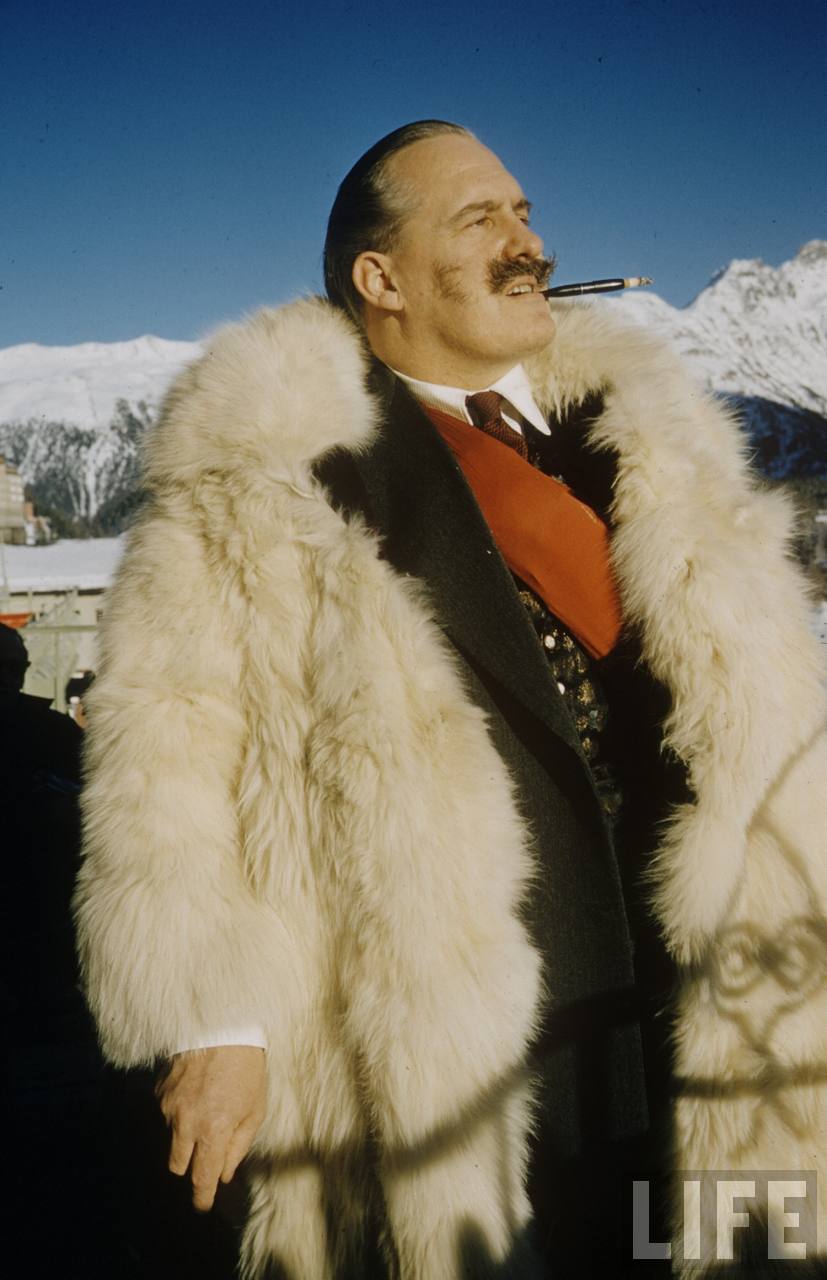 |
| Loomis Dean ~ St. Moritz, Switzerland |
B. V. R. B.
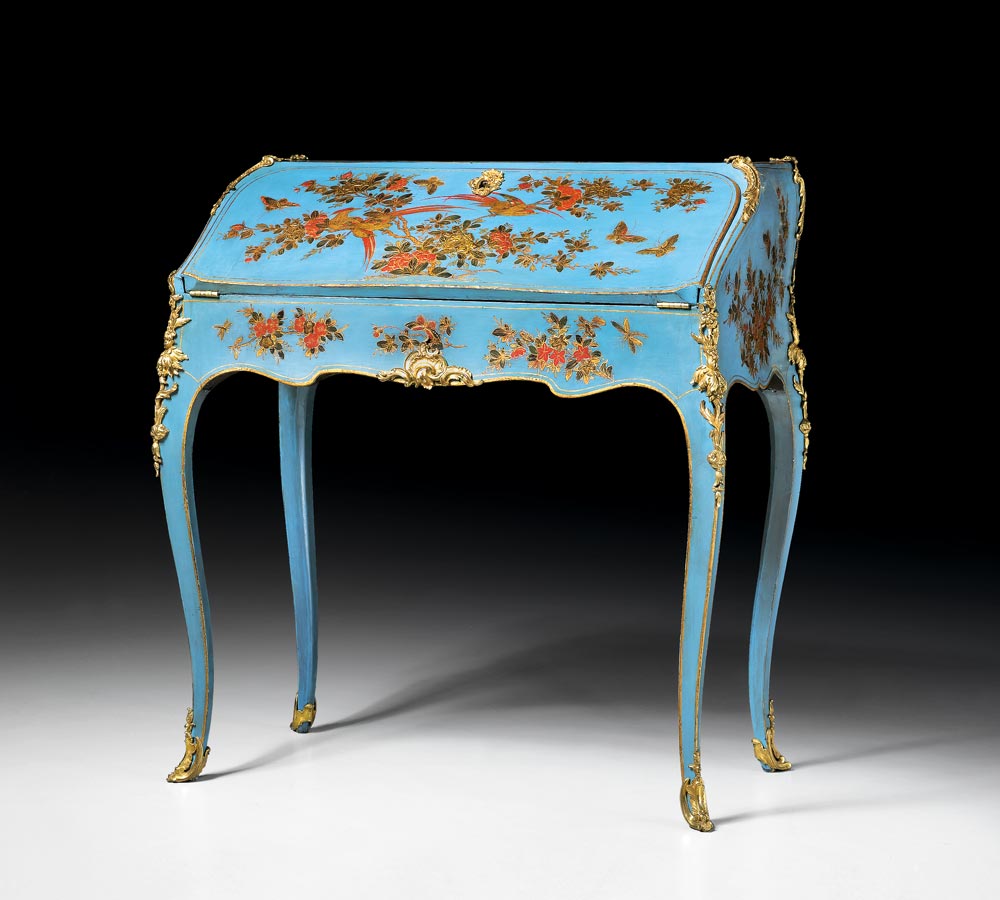 |
| Louis XV lacquer lady’s desk attributed to Bernard II Van Risen Burgh, Paris, ca. 1760 |
Bernard II van Risen Burgh (1696-1766) was an ebeniste of Netherlandish descent who signed his pieces with the elusive monogram B.V.R.B. Not until 1957 was the true identity of this great ebeniste uncovered. Van Risen Burgh was known for his furniture decorated with Japanese lacquer, first appreciated by the French Queen, Marie Leszczinska in 1737. His work is recognized by its gilt bronze mounts that were designed by BVRB himself. BVRB worked mostly with fashionable furniture designers such as Lazare Duvaux and Thomas-Joachim Hebert. He had no contact with aristocratic or royal potential patrons and kept his studio on the Faubourg Saint-Antoine, a more humble section of Paris than most ebenistes chose to set up their shops.
La Folie Des Grandeurs
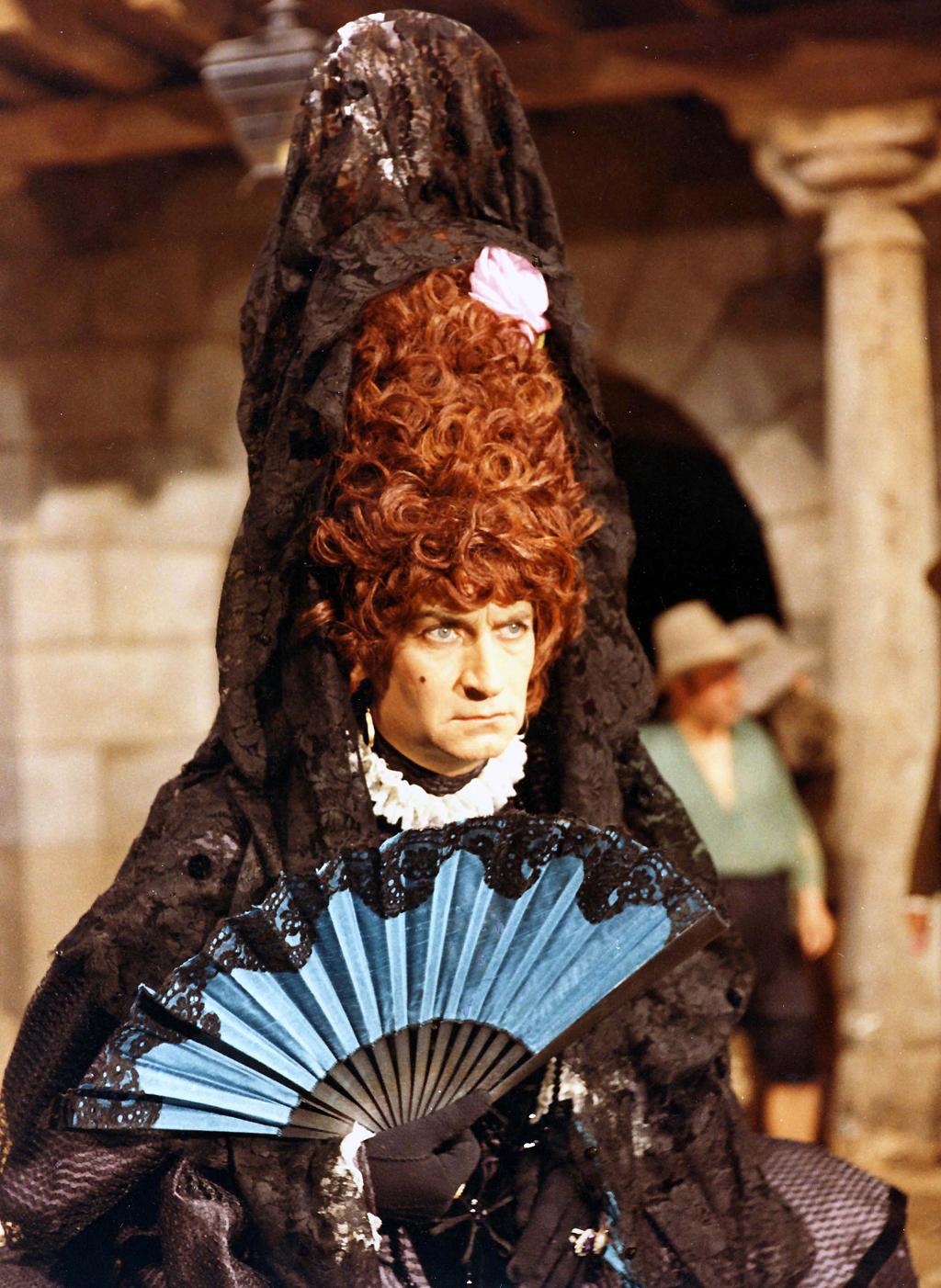 |
| Louis de Funès in Delusions of Grandeur, 1971 |
fo-lie de gran-deur : \ fō̂ lē də grän dër \ (Origin: Fr.) : delusion of greatness : megalomania
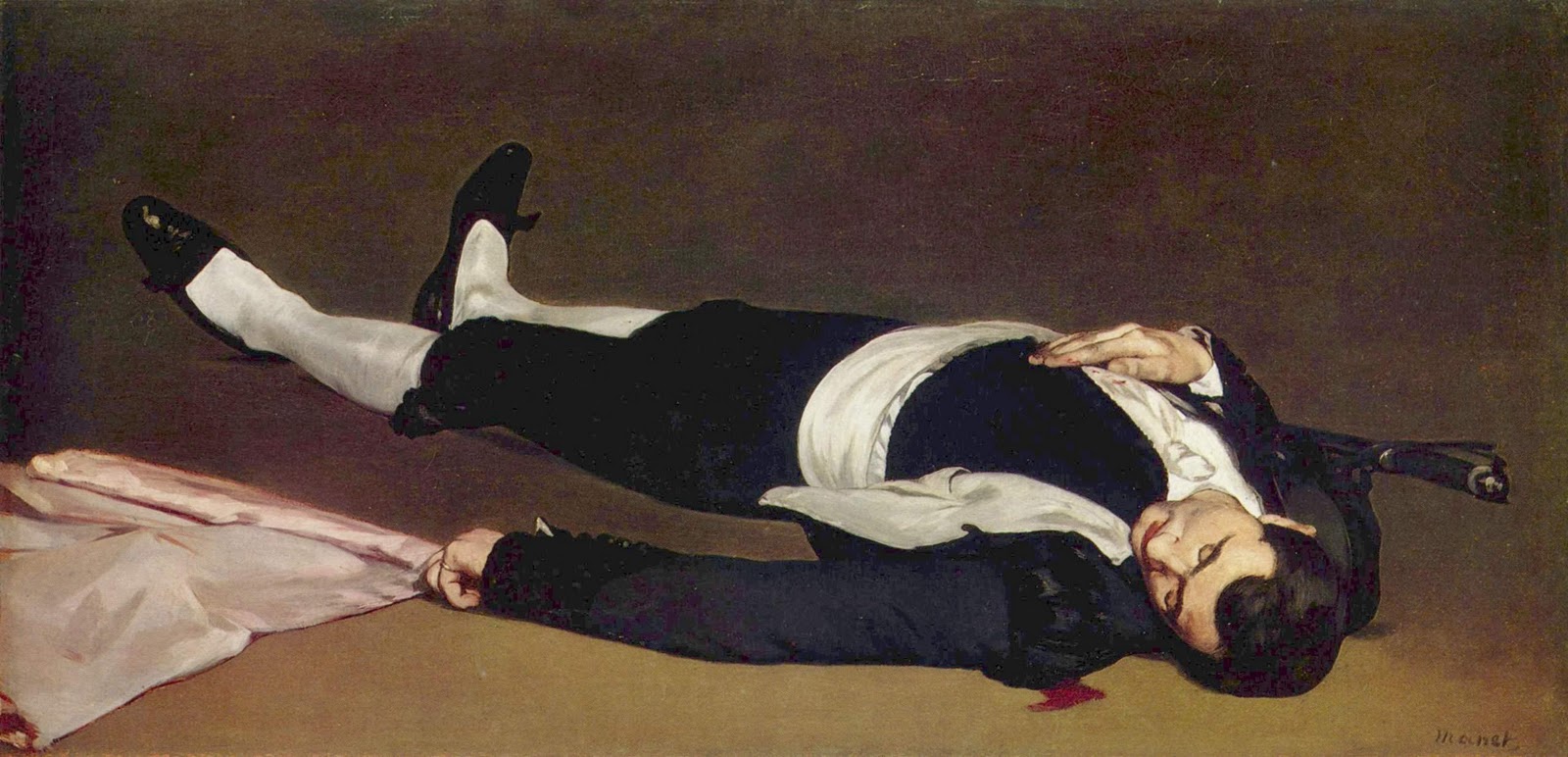
The Dead Toreador
 |
| 1864-1865 |
In 1864 Manet exhibited a large painting he called Episode from a Bullfight. Critics complained that its image of a fallen matador was out of proportion to the bull that had just gored him. “A wooden bullfighter, killed by a horned rat,” one sneered. At some point, Manet cut the painting apart, creating two smaller, more powerful works: The Dead Toreador, here, and The Bullfight, now in the Frick Collection, New York.
Although Manet may have acted in response to the harsh criticism, it was not uncommon for him to rework compositions. He repainted the background, extracting the figure from the context of the bullfight, and in so doing changed the nature of his painting. The fallen matador is no longer part of a narrative but is instead an icon, an isolated and compelling figure of sudden and violent death. From the now featureless background the man’s body is dramatically foreshortened, thrusting toward the viewer. Its proximity and isolation are startling. Only the man’s costume informs us about him, traces of blood the only signs of a painful death.
Manet’s choice of a Spanish subject—he did many early in his career—reflects his interest in the seventeenth-century painter Velázquez, as does the dramatic organization of the composition and his palette of rich, dark tones.
© 2010 2008 National Gallery of Art, Washington, DC
 |
| Manet Manette by Carol Armstrong |
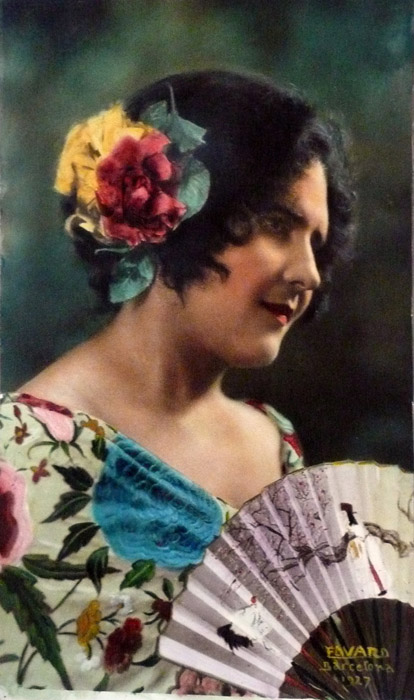
Barcelona, 1927
The Sailor Prince
 |
| HRH Albert Edward, Prince of Wales (later Edward VII), 1846 Franz Xaver Winterhalter |
Couronne du Sacre de Louis XV
 |
| Augustin DUFLOS, d’après Claude RONDÉ Couronne de Louis XV, 1722 Musée du Louvre |
[Déposée à Saint-Denis en 1729 après le remplacement des pierres d’origine, portée à la Convention en 1793, déposée au Cabinet des médailles puis au Garde-meuble, transférée du palais de Trianon au Louvre en 1852. Paris, France. Argent partiellement doré, fac-similés des pierres précieuses d’origine, satin brodé]
Couronne de Louis XV
À l’occasion de leur sacre, les rois de France avaient pour coutume de se faire exécuter une couronne personnelle. Pour Louis XV, deux couronnes furent réalisées : une en or émaillé et l’autre, conservée au Louvre, en argent doré et ornée de pierreries. Cependant, en 1729, cette dernière fut dépecée et on remplaça les pierres d’origine par des copies. La couronne ne servait qu’à l’occasion du sacre et reposait à l’abbaye de Saint-Denis avec les autres instruments de cérémonie, appelés regalia.
Une œuvre toute de perles et de pierres précieuses
La Couronne de Louis XV est composée d’une calotte de satin brodé et cerclée d’une structure métallique d’où partent des arceaux ajourés surmontés d’une fleur de lys. Le bandeau est ceint de deux files de perles et de huit pierres de couleur (saphirs, rubis, topazes et émeraudes) alternant avec des diamants. Le départ des arceaux est marqué par des fleurs de lys formées par cinq diamants. Le célèbre Régent, acheté quelques années avant le sacre, orne la fleur de devant. Les huit diamants quadrangulaires qui constituent le sommet des fleurs appartiennent à la série des dix-huit Mazarins. Enfin la couronne est également surmontée d’une fleur de lys faite de feuilles d’acanthe en argent comportant dix-sept diamants complétés par le Sancy. Sur la calotte sont cousus ving-quatre autres diamants. En 1729, perles et pierres précieuses furent remplacées par des copies à la demande de Louis XV. Au total, la couronne comportait 282 diamants (161 grands et 121 petits), 64 pierres de couleur (dont 16 rubis, 16 saphirs et 16 émeraudes) et 237 perles.
L’oeuvre de joailliers parisiens
La couronne personnelle de Louis XV a été dessinée par le joaillier Claude Rondé et exécutée sous la direction du jeune Augustin Duflos, joaillier du roi aux Galeries du Louvre. Peu de temps après, en 1723, Duflos réalisa chez Rondé une couronne sur le même modèle et suivant les mêmes dimensions pour le roi Joseph V du Portugal. En 1725, les Rondé livrèrent pour la reine une autre couronne de plus petite taille mais de composition voisine.
Les descriptions de la couronne de Louis XV
On connaît deux descriptions de cette œuvre : la première publiée par Le Mercure, un mois après le sacre, en novembre 1722, et la seconde servant de légende à une gravure de Sébastien Antoine. Celle-ci signale bien que la couronne était ornée de 64 pierres de couleur mais elle ne mentionne que 273 diamants et indique quelques variantes par rapport à l’état connu aujourd’hui. Il est donc possible que l’aspect actuel ne soit pas tout à fait fidèle à la composition d’origine et que les différences soient la conséquence de la restauration faite par le joaillier M. Maillard en 1780. Bien qu’ornée de pierres factices et malgré les légères modifications subies, la couronne personnelle de Louis XV nous révèle le faste des cérémonies royales ainsi que la virtuosité des joailliers du XVIIIe siècle.
Documentation: Regalia : les instruments du sacre des rois de France, les honneurs de Charlemagne, Éditions de la Réunion des musées nationaux, Paris, 1987, pp. 91-92
Muriel Barbier
 |
| © Musée du Louvre / E. Lessing
|
The Great Count Don Luchino Visconti Di Modrone


 tout ceci est magnifique