Man Ray’s Indestructible

Objet indestructible  
1923, remade 1933, editioned replica 1965
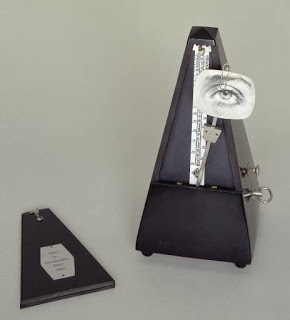
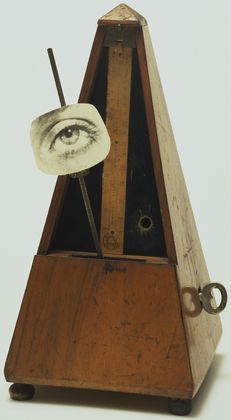
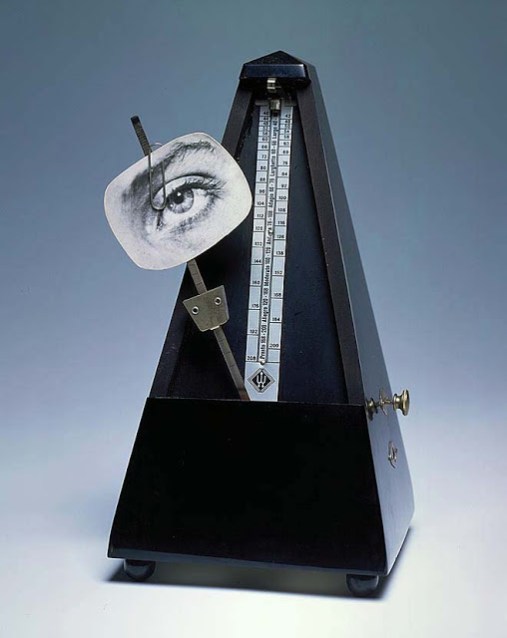
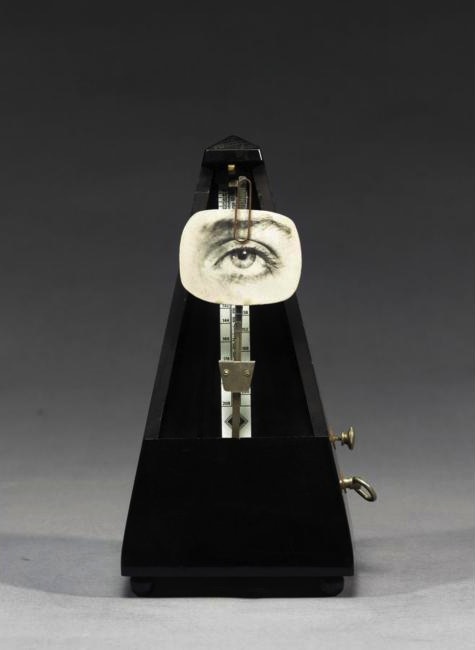
Man Ray’s celebrated combination of a metronome with a photograph of an eye affixed with a paperclip to the swinging arm was first created in 1922-3 and titled Object to be Destroyed (Objet à détruire). As Man Ray later explained: ‘I had a metronome in my place which I set going when I painted – like the pianist sets it going when he starts playing – its ticking noise regulated the frequency and number of my brushstrokes. The faster it went, the faster I painted; and if the metronome stopped then I knew I had painted too long, I was repeating myself, my painting was no good and I would destroy it. A painter needs an audience, so I also clipped a photo of an eye to the metronome’s swinging arm to create the illusion of being watched as I painted. One day I did not accept the metronome’s verdict, the silence was unbearable and since I had called it, with a certain premonition, Object of Destruction, I smashed it to pieces.’ (Schwarz, p.206.)  
In 1933, responding to a series of exhibition requests, Man Ray remade the object. In 1932 he had been left by his lover of three years, the model and photographer Lee Miller, and it was her eye which appeared in this new version. Man Ray had published a drawing of the new version in a magazine called This Quarter. The instructions attached to the drawing revealed the extent of his hurt. He wrote: ‘Legend, Cut out the eye from a photograph of one who has been loved but is seen no more. Attach the eye to the pendulum of a metronome and regulate the weight to suit the tempo desired. Keep doing to the limit of endurance. With a hammer well-aimed, try to destroy the whole at a single blow.’ (This Quarter, vol.I, September 1932, p.55.)
Indestructible Object (or Object to Be Destroyed), 1964 (replica of 1923 original)
The Museum of Modern Art
When Man Ray left Paris as a result of the German invasion of 1940, the 1933 Object to be Destroyed Lost Object, but the title was accidentally printed as Last Object. In the catalogue Man Ray wrote: ‘Last Object or Object of destruction. It is still my earnest desire, some day while the eye is ticking away during a conversation, to lift my hammer and with one well-aimed blow completely demolish the metronome’ (Schwarz, p.206). The work did subsequently get damaged, although not quite as Man Ray had anticipated. In March 1957, it was included in a Dada exhibition at the Galerie de l’Institut in Paris, against which a group of young students, probably from the Académie des Beaux Arts, organised a demonstation. Man Ray was in the gallery at the time the students entered, and he later recalled the events in his autobiography (see Man Ray, pp.306-307). 

In 1958 Man Ray decided to remake the object yet again, this time giving it the warier title Indestructible Object. In 1965 he collaborated with the French artist Daniel Spoerri to make an edition Indestructible Objects. The Tate’s version is number sixteen in this edition. In 1970 Man Ray authorised a further edition of forty sculptures to be made in which the photograph of Miller’s eye was replaced with a double printed image of a blinking eye that opens and closes as the metronome’s arm swings back and forth. As he explained: ‘It finally annoys me always to repeat the same thing, so I introduced a small variation, I changed the eye of the metronome. Well, since I have repeated it now for the third time, I will call it Perpetual Motif. After all, the movement of the metronome is a perpetual motif.’ (Schwarz, p.206.) A further edition of one hundred metronomes was issued by Mario Amaya on the occasion of an exhibition at the New York Cultural Center in 1974. These were known as Do Not Destroy. Two posthumous examples of the object are known to have been produced in Germany and Spain in 1982.
Sophie Howarth, April 2000  
© Man Ray Trust/ADAGP, Paris and DACS, London 2002
Further Reading:
Perpetual Motif: The Art of Man Ray, exhibition catalogue, National Museum of American Art, Washington, New York 1988, pp.47, 226, 252, reproduced p.252
Man Ray, Self-Portrait, London, 1988, pp.97, 305-6
Arturo Schwarz, Man Ray: The Rigour of Imagination, London 1977, pp.205-6, reproduced p.218 
Indestructible Object, 1965
Smithsonian American Art Museum

“Other contraptions of mine have been destroyed by visitors; not always through ignorance nor by accident, but willfully, as a protest. But I have managed to make them indestructible, that is, by making duplicates very easily.” Man Ray, Self Portrait, 1963

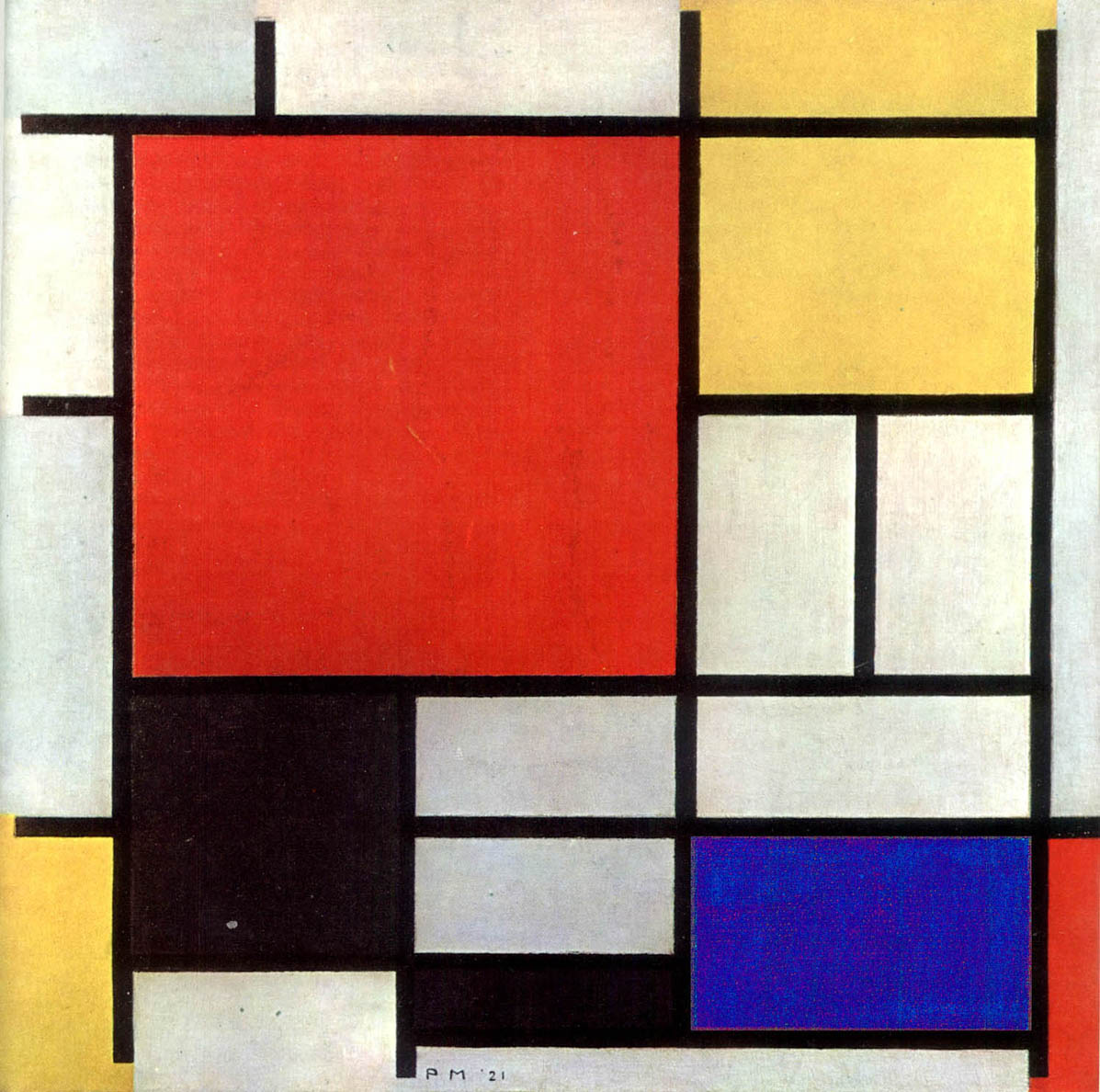
Composition with red, yellow blue and black

Piet Mondrian, 1921

“Art systematically eliminates,” Mondrian said, “the world of nature and man.”  He wanted art to be as mathematical as possible, a blueprint for an organized life.

A control freak, Mondrian even transformed his own environment into one of his paintings.  He covered his studio walls with rectangles in primary colors or gray, white, and black.  Although the studio was as sparsely furnished as a monk’s cell, he kept an artificial tulip in a vase, its leaves painted white (since he had banned the color green.)  He painted all furniture white or black and his record player bright red*.

*red cardboard cover that he built

Mondrian” Harmony of opposites”
Carol Strickland The Annotated Mona Lisa: A Crash Course in Art History from Prehistoric to Post-Modern

Jackpot

 
The History of the Lottery
Scholars disagree on who started the ancient tradition of lotteries, but there are references in the Bible. In Chapter 26 in the Book of Numbers, Moses used a lottery to award land west of the River Jordan.

Lotteries in the Ancient Times:
100 BC:
The Hun Dynasty in China created keno. Funds raised by lotteries were used for defense, primarily to finance construction of the Great Wall of China.
100-44 BC:
Forms of lotteries date back to Caesar.

Lotteries in the Medieval World:
1446:
In one of the first recorded European lotteries, the widow of the Flemish painter Jan Van Eyck holds a raffle to dispose of his remaining paintings.
1465:
Lotteries were held in Belgium to build chapels, almshouses, canals and port facilities.
1515:
Six names were drawn for election to the Senate in Genoa, Italy; later the names were changed to numbers. The word “lottery” is believed to come from the Italian word “lotto”, meaning destiny or fate.
1530:
Florence, Italy held a “Number Lottery” with cash prizes.
1539:
King Francis I of France authorized a lottery to replenish depleted funds in the treasury. Many of these funds had been flowing to foreign lotteries.
1567:
Queen Elizabeth I establishes the first English state lottery. Prizes include cash, plate, and tapestry, with 400,000 tickets offered for sale.

Lotteries in Colonial Times:
1612:
King James I of England, by royal decree, created a lottery in London. The proceeds were used to aid the first British colony in America — Jamestown, Virginia. Interestingly, Anglican churches held two of three winning tickets for the first draw.
1700s:
Many of our Founding Fathers played and sponsored lotteries. Some examples:

• Benjamin Franklin used lotteries to finance cannons for the Revolutionary War.
• John Hancock operated a lottery to rebuild historic Faneuil Hall in Boston.
• George Washington operated a lottery to finance construction of the Mountain Road, which opened westward expansion from Virginia.
• Thomas Jefferson, $80,000 in debt at the end of his life, used a lottery to dispose of the bulk of his property.


Early Modern Lotteries:
1726: The Netherlands formed what is now the oldest lottery still in operation.
1753: A lottery is held in England for the establishment of the British Museum.
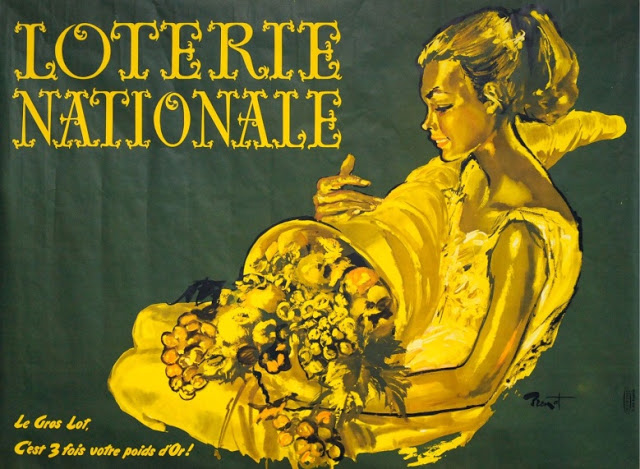
1759: At the urging of Casanova, Louis XV founded the Loterie Royale of the Military School (later on Saint-Cyr) in France. With the advent of this lottery, other lotteries were outlawed and the funds were to be used to reduce the State’s debts. The King thus created a monopoly, which became the forerunner of the Loterie Nationale. The lottery was a keno-style game where players chose to bet on 1,2,3,4, or 5 numbers between 1 and 90.
1776: Lotteries were authorized to raise money for the Colonial Army.
1789: Lotteries were most active during the period following the adoption of the Constitution and prior to the establishment of effective means of local taxation and the wave of anti-lottery reform in the 1830s. Before 1790, America had only three incorporated banks. Therefore, lotteries were standard sources for public and private financing.
1790 to the Civil War: Fifty colleges, 300 schools and 200 churches were erected with lottery proceeds. Most notably, universities such as Harvard, Yale, Princeton and Columbia were funded by lotteries.
1790 to 1860: Twenty-four of the 33 states financed civic improvements such as courthouses, jails, hospitals, orphanages, and libraries through lotteries.
1817: In Lower Canada (now Quebec), a law was enacted to formally ban all types of games. The law failed due to “a taste for gaming that existed in every class.”
1820 through 1878: Corruption in privately operated lotteries becomes rampant. Many award fewer prizes than advertised or award no prizes at all. Governments find themselves unable to regulate these lotteries and as a result begin to consider prohibition.
1820s: New York passed the first constitutional prohibition of lotteries in the United States.
1856: The Act Concerning Lotteries expressly forbade all types of lotteries in Canada. This Act especially affected the French and Catholic clergy, who for close to a century had financed its good works with lottery proceeds.
1878: All states except Louisiana prohibit lotteries, either by statute or in their constitution.
1890: Congress bans all lottery materials from the mail.
1895: Congress bans all lottery materials from interstate commerce.
1905: The U.S. Supreme Court reaffirmed the states’ use of police powers to control gambling, effectively ending the Louisiana Lottery and other gambling in the U.S. No state was directly involved in the operation of a gambling enterprise, and lotteries were prohibited in most states by constitutional provisions for the next 60 years.

Modern Lotteries:
1912: “Totalizator” was legalized, making racetracks the only legal betting place in Canada.
1917: The Queensland State Lottery of Australia was the first lottery to start operations in the 20th century.
1930: Irish Sweepstakes were launched with great success in the American and Canadian markets because of the abolition of lotteries in these countries.
1964: The New Hampshire Legislature created the state lottery, the first legal lottery in this century; it was labeled a “Sweepstakes” and tied to horse races to avoid the 70-year-old federal anti-lottery statutes.
1967: New York became the second state to attempt a lottery.
1969: Amendments to the Criminal Code of Canada legalized gambling and gave provinces the authority to operate lottery schemes and casinos and to license charitable or religious organizations to carry out specified lottery schemes.
1970: New Jersey started a state lottery. Tickets were 50 cents for a weekly drawing. Manitoba and Quebec began the first modern Canadian lotteries.
1971: Led by New Jersey, which in its first fiscal year sold close to $73 million in tickets, lottery sales nationwide surpassed the $100 million mark for the first time.
1971: Automated Wagering implemented the world’s first online system in New Jersey.
1973: The Olympic Lottery Corporation of Canada received its charter and began selling tickets to provide funding for the 1976 Olympics in Montreal. The provinces of Alberta, Ontario, New Brunswick, Newfoundland, Prince Edward Island and Quebec, as well as the Northwest Territories, participated in the Olympic Lottery.
1973: Fiscal year sales for all lotteries surpassed $500 million.
1973: Scientific Games developed the first secure instant ticket.
1974: Massachusetts offered the first scratch-off ticket.
1974: The provinces of Manitoba, Saskatchewan, Alberta and British Columbia, plus the Yukon, formed the Western Canada Lottery Corporation.
1974-76: The Interprovincial Lottery Corporation was created through an act of the Ontario Legislature, and shortly after was federally incorporated with the western provinces.
1975: Federal law was amended to allow state lotteries to advertise on radio and TV.
1975: New Jersey introduced a statewide, online network of several hundred Clerk Activated Terminals (CATs) implemented by General Instrument (now Autotote).
1976: The Delaware State Lottery began taking bets on National Football League games (called the Delaware Sports Lottery). The NFL lost a legal battle to ban this type of wagering. The Sports Lottery was abandoned after 14 weeks.
1976: Newfoundland, New Brunswick, Nova Scotia and Prince Edward Island formed the Atlantic Lottery Corporation.
1976: Lottery sales surpassed $1 billion for the first time.
1978: Both New York and Massachusetts introduced off-line lotto, a European player selection game in which the player selects six numbers between 1 and 30.
1978: Quebec joined the Interprovincial Lottery Corporation.
1979: The Atlantic provinces joined the Interprovincial Lottery Corporation, thus creating a true nationwide lottery in Canada.
1985: Tri-State Lotto, the first multi-state lottery, linked the state lotteries of Maine, New Hampshire and Vermont.
1986: The Illinois Lottery introduced the first instant game with the concept of qualifying “entry” tickets for a grand prize drawing.
1986: North Dakota becomes the first state to vote against starting a state lottery.
1988: Keno was introduced by the New York Lottery.
1988: The Multi-State Lottery Association began with Oregon, Iowa, Kansas, Rhode Island, West Virginia and the District of Columbia as initial members.
1989: South Dakota became the first state in the U.S. to license and regulate video lottery games.
1989: The Oregon Lottery began accepting bets on NFL games, later adding other professional sports teams.
1991: The Virginia Lottery awarded the first instant ticket vending machine contract.
1996: The Big Game began with Georgia, Illinois, Massachusetts, Maryland, Michigan and Virginia as initial members.
1998: The Multi-State Lottery Association recorded a world-record lottery jackpot of $295.7 million for its Powerball game.
1999: Maria Grasso of Boston wins a lump sum prize of $104 million in The Big Game, the largest prize ever won by a single individual.
1999: Thirty-seven states and the District of Columbia operate a lottery in the U.S., while lotteries are legal in all Canadian provinces and territories. More than 100 foreign lotteries exist and many have operated for centuries. Some countries, like Mexico, France and Japan, have national lotteries. The World Lottery Association lists 63 member nations — one on every continent except Antarctica.
2000: The largest lottery jackpot in history is shared by winners from Michigan and Illinois. Both winners of the May 9 Big Game drawing elect to receive cash payments of approximately $90 million as their share of the $363 million (annuity) jackpot.
2006: A new record for thee largest lottery jackpot in history is won by a lotto pool of 8 Nebraskans who will share a $365 million jackpot. 

Lotto Buster
The Laughing Cavalier

THE LAUGHING CAVALIER 
Frans Hals
GERALD S. DAVIES
A SURVEY of the portraits which Frans Hals painted will disabuse the mind of at least one prejudice concerning the great painter. It will go far to put an end to the view, which has been expressed by many writers, that Hals was a mere painter of externals; one who caught the surface peculiarities of a man and could present them to us with astonishing verve and vraisemblance—much, indeed, like Charles Dickens in literature—but who did not penetrate beneath the surface, or read the inner man very subtly. One may fully grant that Frans Hals was not a thinker in the sense in which Rembrandt, Velasquez, and even Van Dyck, were thinkers; and there are, I dare say, very few of us who have not at some time or other, in standing before one of Hals’s brilliant, dashing bits of rapid character-catching, found ourselves expressing the inward doubt whether Hals realized that his sitters had souls at all. The injustice is due, I am persuaded, to the fact that few people have ever taken the trouble to view Hals as a whole. For some reason, there has been an unconscious conspiracy, both among picture-lovers and writers, to think of him through one or two of his most astonishing, and, indeed, incomparable achievements as a rapid setter-down of facial expression. But anyone who has stood long before the gentleman and his wife of the Cassel Gallery; the Jacob Olycan and Aletta Hanemans of the Hague; the Albert Van der Meer and his wife of Haarlem; the Beresteyn pair of the Louvre; the old housewife of the same gallery, and, above all, the consummate portrait of Maria Voogt, 1639, at Amsterdam, not to speak of many others, will have to reconsider his verdict. Hals has shown himself in these to be as perfectly capable of handling a worthy face with quiet dignity and full insight—remember that his sitters were Dutch, who do not carry their souls upon their faces, nor their hearts upon their sleeves—as he was capable of setting down the rapidly-passing expression of his Laughing Cavalier, his Jester at Amsterdam, his Gipsy Girl of the Louvre, and his Hille Bobbe of Berlin. The fact that he painted these latter, and more like them, has no business to rob him of his great reputation as a great translator of the more worthy moods of man, which is due to him on the evidence of a far larger body of witnesses. For if the list of his portraits be perused, it will be found that these laughing drinkers and jesters, by which the world has insisted on judging him, are in quite a small minority. The minority would be probably far more strikingly small, if anything like the tale of his output had survived to us.
And I shall make no separate classification for one kind of portrait and the other. As I have already said, his jesters, his gipsies, his mountebanks, his fisher-boys or his fishwives, are just as much portraits as the others. The fact that he very likely picked some of his models up in his pothouse, and others in the street, and others by the roadside, or by Zandvoort dunes, or in the Haarlem fish-market, and carried them off in triumph to his studio, does not make them a whit less portraits. These were the only kind of sitters who would consent to have their portraits painted to go down to posterity with a face convulsed with laughter, or contorted with some passing expression. He must either use that kind of sitter—not but what I quite admit that Hals probably got great amusement from their company—or abandon that field of art—facial expression under rapid change, which was the problem he was mastering. They are not an edifying set of sitters; far from it; but the artist who wants to get a model who will sit to him with a broad grin on his face will not find his man among the high-bred, the serious, the refined. The man who will sit in a studio with a stoup of ale on his knee and laugh boisterously at little or nothing at all, between the drains, is not a refined person. But he gets the lines of his face into the shapes which express laughter more frequently than the doctor of laws or the professor of mathematics, and Hals can get what he wants from him, and perhaps a rough joke or two into the bargain.
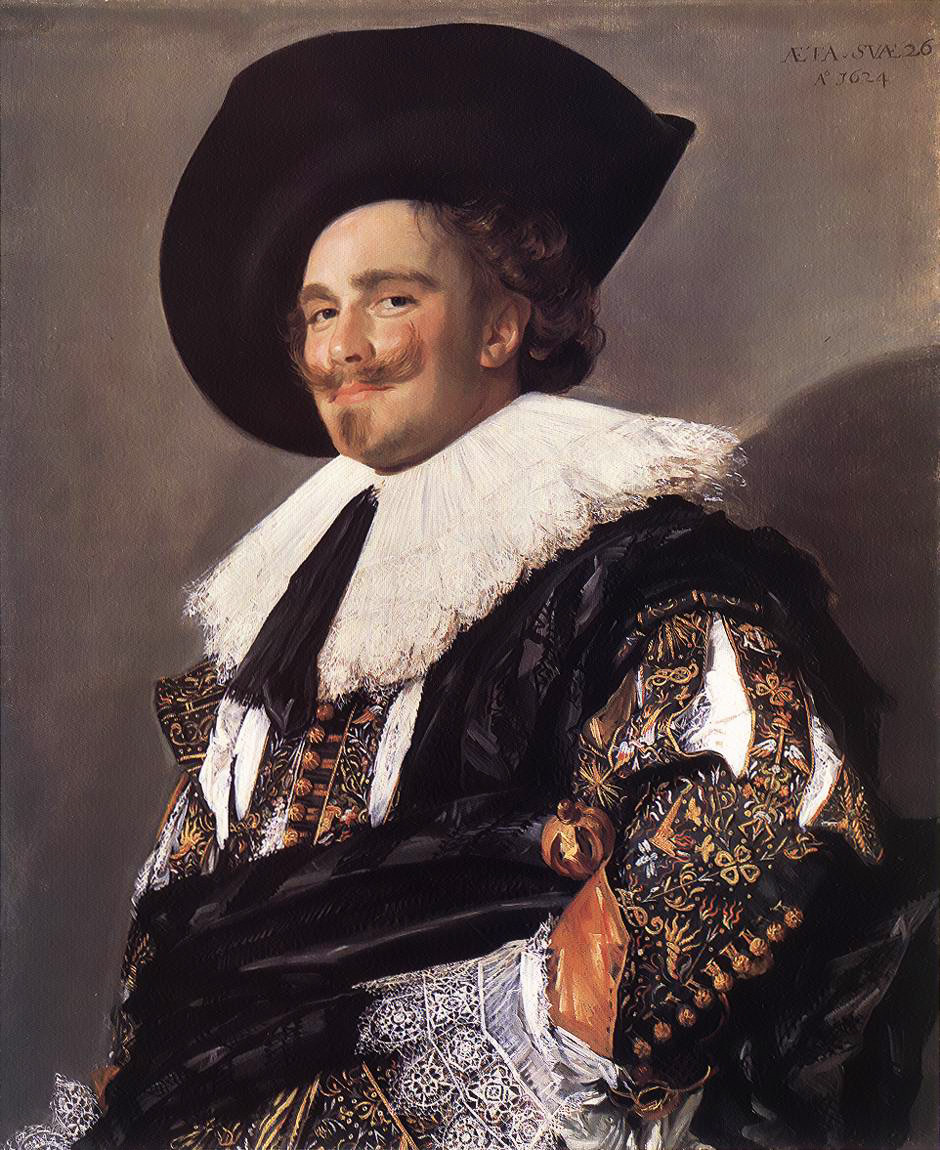
One year before Hals had completed the Olycan pair (Jacob Olycan and his wife, 1625, both at The Hague,) he had painted his Portrait of an Officer—known as The Laughing Cavalier—of the Wallace Collection, 1624. Of Hals’s work accessible in public galleries of England, no more striking specimen exists. Here, indeed, we have the painter rejoicing in the interpretation of a phase of character which had particular attractions for him. The cavalier is a young, well-fed, well-kept soldier, quite satisfied with himself, and evidently quite untroubled by any of those deeper searchings of the mind which are apt to leave their print upon the face. The smile upon his face is certainly one of the most irresistible things that ever was painted. It is not a laugh, nor a leer, nor a grin, but a smile which seems ready to burst into a laugh, and, as you watch the face, it takes slight and rapid variations of expression, so that you seem to see the look which has just passed and that which is just to come. No doubt there is a certain air of swagger,—a characteristic which Hals always enjoyed the rendering of. But this is no mere swaggerer or swashbuckler. On the contrary, there is a force and even a fineness about the handsome brows that tell you this would be a bad man to have to meet in an encounter, and a good man to have to follow to one. Stand before this man’s portrait, and you can weave for him a history. There is something more than mere swagger in that self-assertive smile. He looks out at you with an air of supreme contempt at one moment, of supreme good-nature at another; but the expression is full of changefulness, full of that electric current which plays over the human face and tells you while you look at it at one moment, what to expect from the next.
This was not a reader or a thinker, but he was not a mere vapourer or a mere braggart, like the Merry Toper of the Amsterdam Gallery. A fighter you may make oath upon that, and a man of action when he is wanted.
Technically it is the highest merit, and is nearly, if not quite, as it left the painter’s hands. Even as it hangs on that wall in the company of Rembrandt, of Van Dyck, of Velasquez, it yields to none in that particular. It is for a man’s portrait more highly wrought than is his wont. The handling is not so fierce, if one may use the expression, as, for example, in his Doelen pictures. It represents the halfway between the St. Joris of 1616 and the St. Joris of 1627. Viewed close, the detail is somewhat more exact and less the production of summarized knowledge than is often the case. Even the lace collar is, for a man’s portrait by him, highly wrought.

There is no strong colour in the picture. The elaborate broidery is all in low-tone orange-yellow on a cloth of blue gray. There is not a bit of pure vermilion, or crimson, or blue in the picture. And yet the impression left by the picture certainly is that its scale is somewhat higher than many of Hals’s individual portraits. The explanation lies doubtless in the fact that the picture is slightly wanting in atmosphere, and does not go behind its frame.
[Book digitized by Google from the library of the University of Michigan and uploaded to the Internet Archive by user tpb]

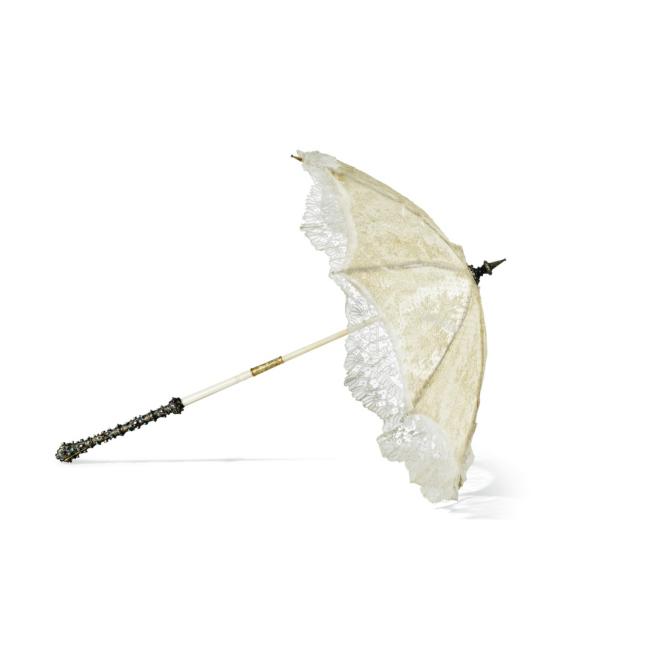
Parasol

ca. 1850

~ Parasol Flirtation ~  Long ago, parasols were used to communicate a Lady’s thoughts graciously; they were used for more than just accessories to women’s attire. Below are some meanings associated with a Victorian Lady’s parasol motions

· Carrying it elevated in the left hand- Desiring acquaintance

· Carrying it elevated in the right hand- You are too willing

· Carrying it closed in the left hand- Meet you on the first crossing

· Carrying it closed over the right hand- Follow me

· Carrying it over the right shoulder- You may speak to me

· Closing it- I will speak to you

· End of tip to lips- Do you love me?

· Folding it up- Get rid of your company

· Tapping the chin gently- I am in love with another

· Twirling it around- Be careful, we are watched

· With handle to lips- Kiss me 

Bleu céleste

Vincennes
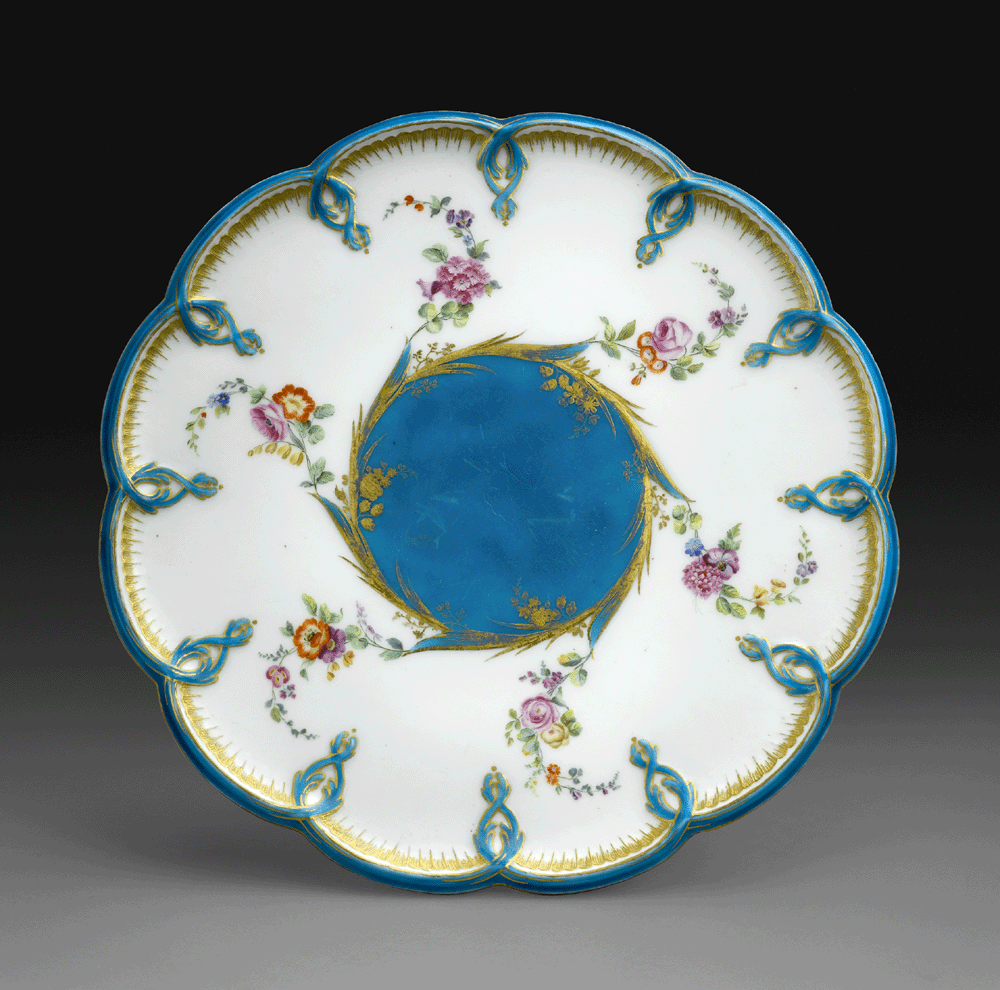
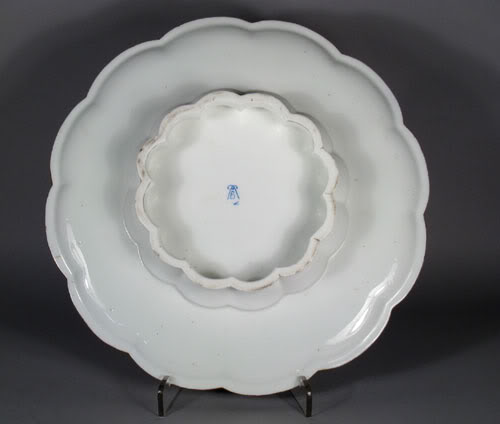
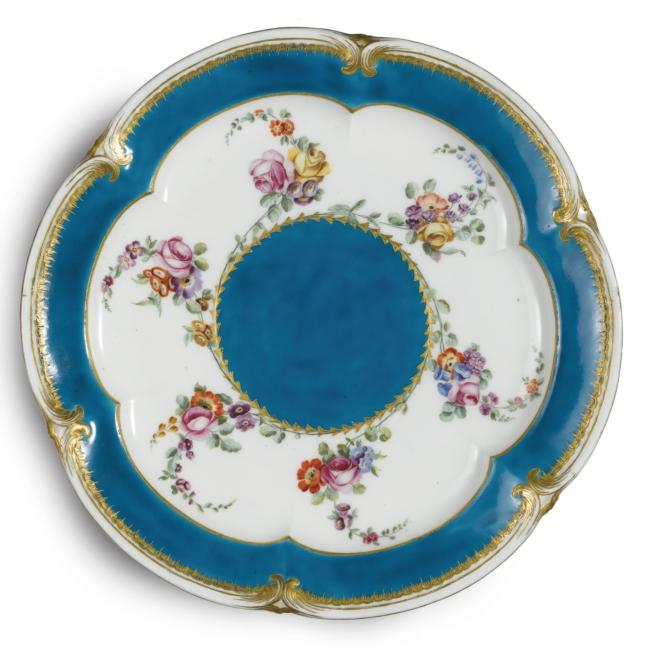
Soucoupe à pied en porcelaine tendre provenant du service bleu céleste de Louis XV à décor polychrome au centre d’un médaillon à fond bleu céleste cerné de feuillage et fleurs or et de guirlandes de fleurs polychrome, le bord est décoré de palmes en relief à fond bleu céleste et peignés or. Marquée en bleu : LL entrelacés, lettre-date B pour 1754-1755.
XVIIIème siècle, année 1754-1755. Diam. : 22,8 cm. Petite usure au centre

Vendu 27.600,00 euros – Etude Binoche & Giquello – 10 avril 2009, Hôtel Drouot
CATALOGUE NOTE
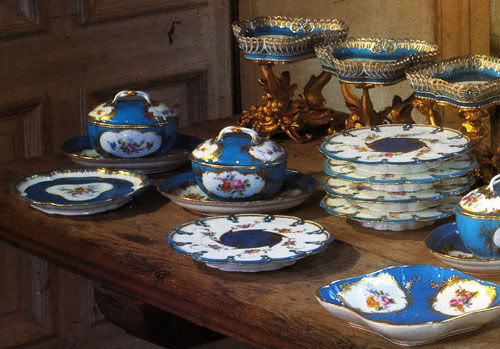
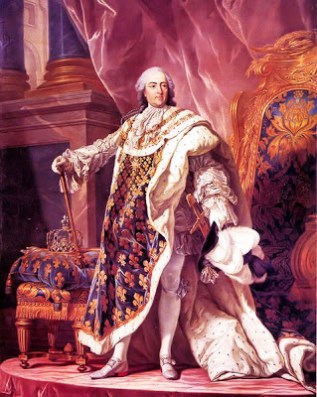
Premier grand service de la manufacture de Vincennes, le service de Louis XV est commandé à la manufacture en 1751 pour le château de Versailles.
Le dessin des formes est confié à l’orfèvre Jean-Claude Duplessis Père et pour ce service, le fond de couleur bleu céleste (également nommé Bleu Hellot ou bleu ancien) est mis au point par le chimiste Jean Hellot.

[Jean Claude Ciambellano dit Duplessis père (1690-1774)
Orfèvre et bronzier. A partir de 1748 et jusqu’à sa mort, il dessine la plupart des formes de la Manufacture de Vincennes/Sèvres, en venant régulièrement surveiller leur mise en oeuvre. Il met au point, en 1755, un tour spécial pour le calibrage des modèles ovales qui lui vaut le titre d’Orfèvre du Roi. Son fils, Jean Claude Thomas, travaille également pour la Manufacture de 1752 à sa mort en 1783.]

La livraison du service s’échelonne entre 1753 et 1755. La première partie du service, livrée le 24 décembre 1753, est exposée au public à Paris chez le marchand mercier Lazare Duvaux rue Saint honoré. Elle est ensuite envoyée par le marchand à Versailles au début du mois de février 1754. Le duc de Croÿ relate dans son journal qu’après un dîner à Versailles, Louis XV nous occupa à déballer son beau service, bleu, blanx et or, de Vincennes, que l’on venait de renvoyer de Paris, où on l’avait étalé aux yeux des connaisseurs. (Journal inédit du duc de Croÿ (1718-1784), I, pp.230-231.)
Les deuxième et troisième livraisons du service ont lieu le 31 décembre 1754 et le 31 décembre 1755.
Une importante partie du service (environ cent quarante pièces dont soixante douze assiettes) est vendue en juillet 1757 par Louis XV à Etienne-François de Choiseul, comte de Stainville-Beaupré (futur duc de Choiseul-Stainville en 1758) par l’intermédiaire de Lazare Duvaux. Choiseul est à ce moment ambassadeur de France en Autriche.
Louis XV ainsi que Choiseul achètent l’un et l’autre des compléments de ce service à la fin des années 1750 et dans les années 1760. La partie de service restée dans les collections de la couronne est mentionnée dans un Etat des Porcelaines de Sèvres déposées dans les Offices du Château du Petit Trianon dressé en juin 1778 et conservé aux archives nationales (AN K506, n° 21). Louis XVI achète également des compléments dans les années 1770 et 1780.
Le service est aujourd’hui dispersé. Une importante partie (trente deux pièces) se trouve dans une collection européenne, une autre partie dans les collections du duc de Buccleuch à Boughton House (quatre vingt-dix neuf pièces) dont les seules huit autres soucoupes à pied aujourd’hui répertoriées. D’autres éléments sont conservés dans plusieurs musées : au Château de Versailles, au musée du Louvre, au musée des Arts décoratifs, au musée de Sèvres, au Victoria and Albert Museum et au Metropolitan Museum notamment.

Collection du duc de Buccleuch, Boughton House, Angleterre
BIBLIOGRAPHIE
Pour une étude précise du service voir David Peters Sèvres Plates and Services of the 18th Century, 2005, Vol. II, n° 54-1, 54-2 et 55-1, pp 283-290. 


Voir également : Pierre Grégory, « Le service bleu céleste de Louis XV à Versailles, quelques pièces retrouvées », La Revue du Louvre, 2.1982, pp.40-46 David Peters, Versailles et les Tables Royales¸ catalogue d’exposition, « Les services de Porcelaine de Louis XV et Louis XVI », pp.110-112, Rosalind Savill, « L’apothéose de Vincennes, le service de table de Louis XV », Dossier de l’Art, n° 15, décembre 1993, pp.14-21.

Cyrille Froissart Expert en céramiques anciennes 

 Louis XV’s bleu céleste service marks a turning point in the history of the Vincennes porcelain factory. The new rococo shapes designed for it by Jean-Claude-Thomas Duplessis formed the basis for the factory’s production of servicewares until the Revolution, and the bleu céleste ground, invented for the service, was inspired by the “Celestial Empire”, but it was also the colour of the ribbon of the King’s most important order of chivalry, the Saint Esprit.

Bleu céleste, the factory’s finest and most expensive ground colour, was employed from 1753. At first, it was made using ground-up turquoise-coloured Venetian glass. This technique produced an intense, cloudy and uneven surface, which was nevertheless extremely aesthetically pleasing. In 1756, a cheaper method was developed, resulting in a more even and, paradoxically, less attractive finish.

When the service was first unveiled at Versailles at one of Louis XV’s intimate supper parties, on 4 February 1754, one of the guests, the duc de Croÿ, described the scene: “The King made us unpack his beautiful blue white and gold service from Vincennes, which had just arrived from Paris, where it had been exhibited for connoisseurs to admire. This is one of the first masterpieces of this new porcelain factory which intends to surpass and supplant Meissen. The Marquise [Madame de Pompadour], to whom the King has given the village of Sèvres, is embarked on important building works for this factory next to her glass factory.”

 John Whitehead, Selected Writings