 |
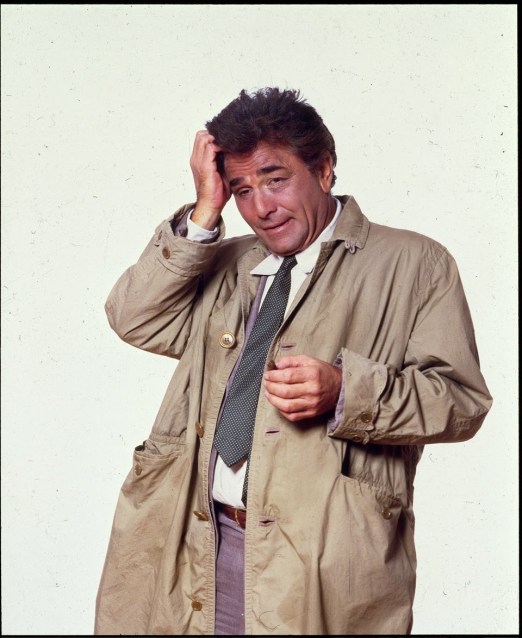
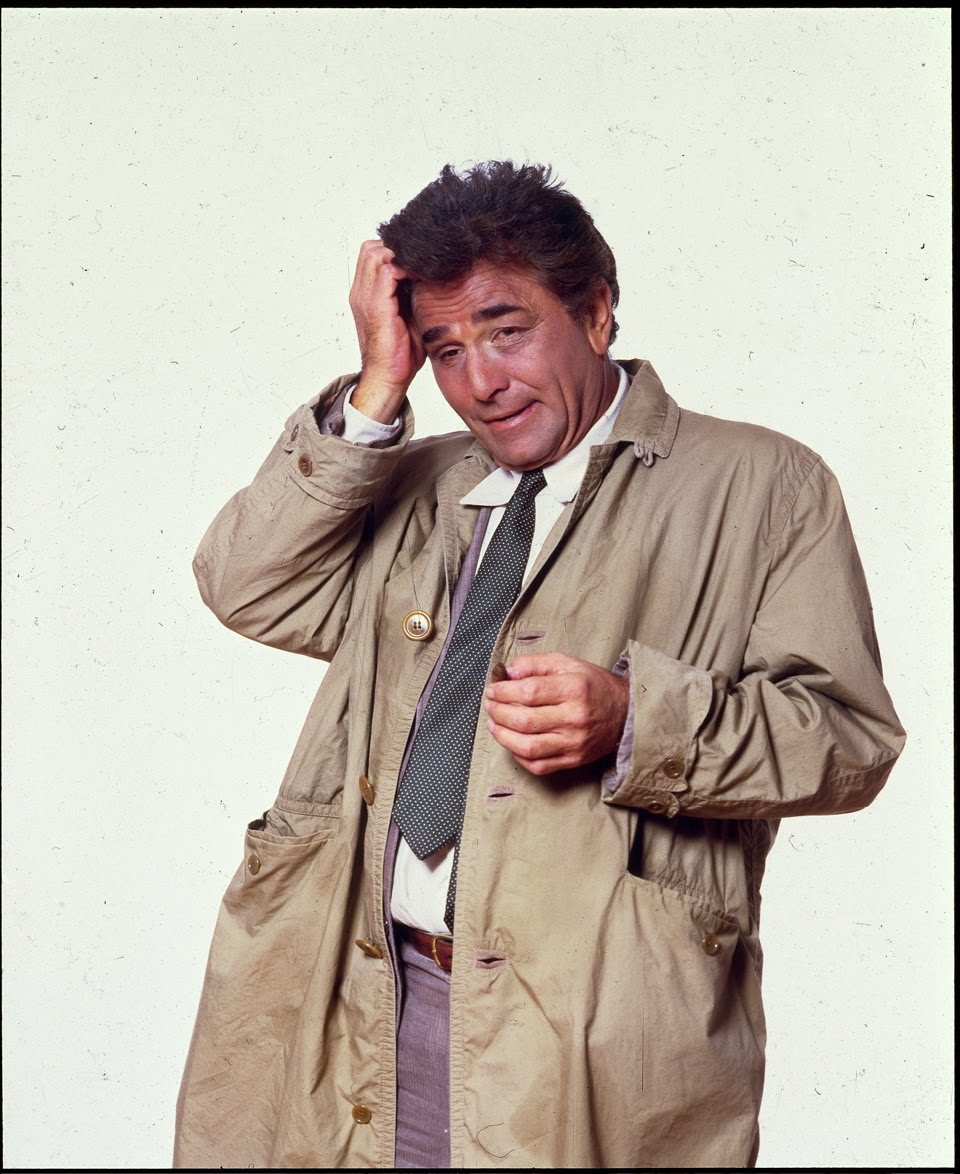
| Peter Falk as Lieutenant Columbo |
The character (who never had a first name), and the series are a creation of the writing/producing team of Richard Levinson and William Link. Columbo ran as a television series from 1971 to 1978, but the character had appeared in a short story, a live-television broadcast, and a stage play before making his first network television appearance in the Made-For-Television Movie Prescription: Murder (1968). Originally written for Bing Crosby, the Columbo role went to Falk when Crosby opted not to end his retirement.
The series’ original run was not in weekly hour-long episodes, but as a 90-minute “spoke” in the NBC Mystery Movie “wheel” concept: each week, one of three different series was shown on a rotating basis. Columbo was interspersed with McMillan & Wife (starring Rock Hudson and Susan Saint James), and McCloud (starring Dennis Weaver. This suited Falk and the producers just fine since the pace of production would be much slower than was usually the case with weekly series. The 90-minute program length also allowed each episode to be more intricate than the typical one-hour installment, and intricacy was stock in trade for the character.
Columbo was not a “who-done-it.” Indeed, the most distinguishing aspect of the series is the plot structure itself. Although this structure is just as rigid and successful as that in Perry Mason, Dragnet, or The Rockford Files, each episode is actually an inversion of the classic detective formula. In the classic formula, the crime is committed by an unknown person, a detective comes onto the case, clues are gathered, the detective solves the crime with the aid of his/her assistants, and the ability of the detective is proven true. In each Columbo plot, the crime and the culprit are shown in great detail. The audience sees the murder planned, committed, and covered up by the murderer. Since the audience knows who did it and how, the enigma becomes “how will Columbo figure it out?” The methods of the murderer are presented with such care that there is little doubt that the horrible crime will go unpunished–little doubt until Columbo comes onto the scene.
With his rumpled overcoat, stubby cigar, tousled hair and (apparently) confused attitude, Columbo rambles around in his old Peugeot, doggedly following the suspect of a homicide. The attitude and behavior, however, are all an act. Columbo is not confused but acutely aware, like a falcon circling its prey, waiting for a moment of weakness. Columbo bumbles about, often interfering with the activities of the uniformed police and gathering what seem to be the most unimportant clues. All the while he constantly pesters the person he has pegged as his central suspect.
At first even the murderer is amused at the lieutenant’s style and usually seems inclined to assume that if this is the best the Los Angeles police can offer, the murder will never be found out. But whenever the suspect seems to be rid of the Lieutenant, Columbo turns with a bemused remark, something like “Oh, there’s just one more thing ….” By the end of the episode, Columbo has taken an apparently minor discrepancy in the murderer’s story and wound it into the noose with which to hang the suspect. Conclusions often feature a weary, yet agreeable, criminal admitting to his or her guilt as Columbo, in the form of some imaginative turnabout, delivers the final blow. If the suspect is a magician, the Lieutenant uses a magic “trick”. If the crime was done by knowledge of movie special effects, Columbo uses similar special effects.
Columbo is the only regular character in the series. There is no grizzled police commissioner, no confidant with whom the case could be discussed. For Columbo, each guest villain becomes something of an ironic “Watson”. Columbo and the murderer spend most of the story playing off each other. The Lieutenant discusses the twists and turns of the case, the possible motives, the implications of clues with his primary suspect, always rich, powerful, and arrogant, always happy to match wits with the apparently witless policeman on the doorstep. In the end the working-class hero overcomes the wealthy, privileged criminal.
Many influential writers, directors, and producers of the 1980s and 1990s worked on this series. Stephen J. Cannell (The Rockford Files, The A-Team, Wiseguy), Peter S. Fisher (Murder, She Wrote), and Steven Bochco (L. A. Law, Hill Street Blues) were writers. Dean Hargrove (Matlock, Perry Mason) and Roland Kibbee (Barney Miller) were producers. The premiere episode was directed by a very young Steven Spielberg. Each episode featured a well-known character actor or minor star as the murderer. Robert Culp and Jack Cassidy had the highest number of returns as guest villain (three each).
Columbo won seven Emmys over the first run of the series, including three for Falk and one for the series itself. Columbo spawned only one spin-off, NBC’s short-lived, Mrs. Columbo (name later changed to Kate Columbo, Kate the Detective, and Kate Loves a Mystery) with Kate Mulgrew in the title role. This series played against Columbo in several ways. Instead of Mrs. Columbo being absent each episode, the lieutenant was “unavailable”. And here the plot followed the traditional detective format instead of the inverted one. It is not clear what caused this series to fail, but Mrs. Columbo was ill fated and ill advised. Both Link and Levinson disavowed it and Falk disliked the concept.
Following the success of Raymond Burr’s return as Perry Mason in a series of Made-for-Television Movies, Falk returned to Columbo on 6 February 1989, for a new “mystery wheel” concept (this time on ABC and alternating with Burt Reynolds in B. L. Stryker and Lou Gossett, Jr., in Gideon Oliver). Just as he left Rock Hudson and Dennis Weaver behind during his original run, the rumpled detective was the only one of the new “wheel” to survive. Indeed, like the character, Columbo always seems to be coming back as if to say “Oh, there’s just one more thing . . .”
–Dennis Bounds



 Louis Eustache Ude
 tout ceci est magnifique