Brain scientist and Nobel laureate Rita Levi-Montalcini tells Richard Owen why she wants to forget turning 100
“The professoressa is a bit tired,” an adviser to Rita Levi-Montalcini warned me as I prepared to interview Italy’s Nobel prize-winning Life Senator on the eve of her 100th birthday. “Don’t wear her out.”
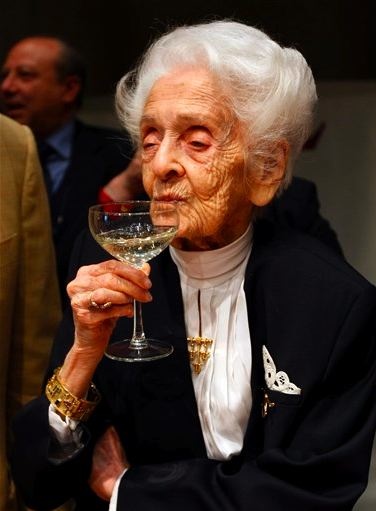
I arrive to find the professoressa, as she is universally known, in the dress shop below her office in Rome, in an elegant black dress buttoned to the neck and a gold brooch of her own design, white hair immaculately coiffed, examining the rails of clothes with close and lively attention.
She is about to catch a plane for Sicily, she says, to address a conference, but can spare some time. In the office Levi-Montalcini, a diminutive, bird-like figure with an alert manner and engaging smile, speaks for more than an hour with an insight, stamina and sharp intellect that someone half her age would envy. Tired at 100? I don’t think so – but pessimistic, yes. This astonishing woman – who studied medicine, survived Fascism and prejudice, and went on to win the Nobel Prize in 1986, who still takes an active part in politics in the Senate, is planning another book and campaigning for the rights of women in Africa – thinks we are all doomed.
For Rita Levi-Montalcini is a global expert on the brain. She founded the European Brain Research Institute (EBRI) in Rome five years ago, and marked her 100th birthday last Wednesday not with a party but with an EBRI seminar at Rome’s city hall on Capitol Hill, entitled “The Brain in Health and Disease”, with speakers from all over the world. She herself delivered the opening remarks. “The brain has two hemispheres” she says, “one ancient or archaic, which governs our emotions and instincts, the other younger, which governs our capacity to reason. Today the archaic brain tends to dominate. It is the cause of all the tragedies that happen like the Shoah (the Holocaust) and it is putting an end to humanity today. It was the part of our brains which got us down from the trees, but it is the cause of all the disasters and the cause of the great danger to our planet today. It is taking the human race toward extinction. The end is already at hand.”
Crikey. Is there no hope? There are some good people in the world, after all. “ Unfortunately, human behaviour is not merely a result of genes. A child from the age of 2 or 3 absorbs what is in the environment around him or her, and what generates hatred for anyone perceived to be ‘different’ – we absorb everything that is in around us, whether it is anti-Semitism or the other forms that this hatred takes.
“All the things that camouflage themselves as ‘intelligence’ and reasoning are in reality instinct – and low-level instinct at that.” Hence terrorism, fundamentalism and weapons of mass destruction, and hence “totalitarian regimes such as those of Mussolini and Stalin that govern not by reason but by archaic instinct. The danger is that in moments of tragedy this is the side of the brain which prevails and controls our behaviour, and these are the kind of people who prevail.”
Does she see a danger today of a resurgence of xenophobia and racism? “Yes, I do, absolutely. Because in critical moments, in moments of great crises, as I said, we tend to use the instinctive part of our brains, not the reasoning, rational part.”
We are sitting not far from the Villa Torlonia, Mussolini’s Rome villa, now a museum and park. Did she feel frightened during the Fascist period? “No. I felt disdain and hatred for Mussolini, not fear.” At university in Turin, her home town, which she entered in the 1930s – when Fascism was at its height – she did not realise she faced persecution because she was Jewish.
“My university friends, who were Catholics, naturally, did not see any difference between myself and them. I didn’t feel any sense of danger when the persecutions started, it was all outside my experience.”
The initial obstacle to entering university was not Fascism, but her father. In her autobiography she writes that she and her twin sister Paola (an artist who died in 2000 and whose artworks decorate her office walls) were born to Adamo Levi, “an electrical engineer and gifted mathematician”, and Adele Montalcini, “a talented painter and an exquisite human being”. There were two older siblings, Gino and Anna, also both now dead.
“The four of us enjoyed a most wonderful family atmosphere,” she writes, “filled with love and reciprocal devotion. Both parents were highly cultured and instilled in us their high appreciation of intellectual pursuit. It was, however, a typical Victorian style of life, all decisions being taken by the head of the family, the husband and father.
“He loved us dearly and had a great respect for women, but he believed that a professional career would interfere with the duties of a wife and mother. He decided that the three of us – Anna, Paola and I – would not engage in studies which open the way to a professional career, and that we would not enroll in the University.” Asked about her father, she says, without bitterness, that he “was a person of great intellectual and moral value, but he was a Victorian. As a child, I saw him as a person who dominated everything I did.”
It was because she felt that her mother was also “dominated” that Levi-Montalcini never married. “I decided I would never marry and I kept my word. I did not want to be ‘in second place’ like my mother, whom I adored. I told my father I did not intend to be just a wife and mother. I didn’t know I wanted to be a scientist then, I didn’t know what science was, but I wanted to dedicate my life to helping others.
“I decided to study medicine. My father didn’t approve but he could not stop me.” She smiles. “I was 20 by then.” What she got from her family, she says, were “values: we were free from the religious point of view, that was not imposed, but behavioural standards had to be rigorously good. The sense of duty was strong in the family, we were never rewarded or punished. We had to behave properly and with decorum.”
The family was descended from Sephardic Jews from Spain who came to Italy in the 14th century, but she is resolutely “a lay person”. “I was very proud of Spinoza, for me he was a great Jewish thinker. But there was never a sense of pride, no sense that we were better than other people. This never entered our way of thinking. I felt Jewish, but also very Italian. I never had religious instruction. When people asked me what my religion was I told them I was a ‘free thinker’, though no one knew what I meant – not even me.”
At the University of Turin she sat at the feet of “the famous Italian histologist, Giuseppe Levi. We are indebted to him for a superb training in biological science”. She graduated in 1936 with a summa cum laude degree in medicine and surgery, and enrolled in the three-year specialisation in neurology and psychiatry. “I was still uncertain whether I should devote myself fully to the medical profession or pursue research in neurology.”
This time it was Mussolini who stood in the way, with the 1938 racial laws barring academic and professional careers to non-Aryan citizens, and then Italy’s entry into the Second World War in 1940. Instead of leaving Italy, the Levi-Montalcinis determined to stick it out. “I decided to build a research unit at home and installed it in my bedroom,” she writes in her autobiography. “My inspiration was a 1934 article by Viktor Hamburger reporting on the effects of limb extirpation in chick embryos.”
When the bombs began to fall in Turin she moved to “a country cottage, where I rebuilt my mini-laboratory and resumed my experiments.” When Mussolini was deposed in 1943 and the Germans occupied Italy the family fled to Florence, where it lived “underground”, secretly supporting the partisans until the Allies arrived in August 1944. She volunteered as a doctor for the Allied forces, helping war refugees and dealing with typhus and other diseases.
After the war she returned to Turin University, but was invited by Hamburger to join him in the US, at St Louis, to “repeat the experiments which we had performed many years earlier on the chick embryo”. She stayed until 1977, becoming a full professor, and founding a research unit in Rome and heading the Institute of Cell Biology at the Italian National Council of Research. In 1986 her crowning achievement was the Nobel prize for discovering the Nerve Growth Factor.
Her discovery, she says, was the highlight of her long life. “I immediately understood the importance of this discovery, which is more important today than it was then and which went completely against the dogmas of the time. The recognition in Stockholm gave me great pleasure, but it does not compare with the moment of the discovery itself, when I realised I was opening up a whole new scenario.”
Italy today has “immense human capital, a huge capacity for innovation, for tolerance and a capacity to live together in this beautiful country. And Italians are proud of their country and their past.”
What does she think of Silvio Berlusconi? “Let’s say that I am on the Left and Berlusconi isn’t.” She has in the past referred to the fact that Italy’s Catholic culture conditions attempts to introduce more liberal laws on bio-ethical issues, from artificial insemination embryo research and living wills. So what did she make of Pope Benedict XVI’s controversial remark that condoms “aggravate” the fight against Aids by encouraging promiscuity?
“It didn’t convince me as a scientist. But I was the first woman to be given the honour of being admitted to the Pontifical Academy of Sciences and I have enjoyed excellent relations with the Popes.” She is proud of her foundation to help African women, which raises money to help them study at university. “So far we have funded 7,000.”
Male and female brains, she insists, are genetically identical. “But men have always imposed their will on women, by their physical force.” She still goes regularly to her European Brain Research Institute, on the outskirts of Rome, where she encourages a team of women scientists “who are extremely talented. But I don’t differentiate between men or women.”
Do the workings of the brain still hold mysteries? “No, it is much less mysterious. We have the most amazing scientific and technological advances. We have been able to see how the brain does work. And now discoveries are being made by by anatomists and physiologists or experts in behavioural science, physicists and mathematicians, computer experts, biochemists, and molecular scientists. The barriers are breaking down between disciplines. At 100 years of age I am still making discoveries about the factor that I myself discovered more than half a century ago.”
As for herself, “my sight and my hearing aren’t as good, but the brain is fine. I believe I have a higher mental capacity today than I had when I was younger, with all the experience I have lived”. And her birthday? “I’m trying to forget about it. It just happened that I was born 100 years ago, merit had nothing to do with it. The secret of life is to keep thinking. And to stop thinking about ourselves. That’s the only message I have.”
Apart, that is, from the secret of death. “I am indifferent to my own death, that only affects my body. What will remain of me is what I have achieved, the work I have done during my lifetime. You don’t die at the time of your physical death. Your message lives on. I am not in the least frightened of dying, it will only affect this very small body that I have lived in. It is not important when I die. The important thing is to have lived with serenity using the rational left-hand side of one’s brain, and not the right side, the instinctive side, which leads to misery and tragedy.”
How to live to 100
If you want to live to a 100, you might consider following Rita Levi-Montalcini’s routine: get up at five in the morning, eat just once a day, at lunchtime, keep your brain active, and go to bed at 11pm.
“I might allow myself a bowl of soup or an orange in the evening, but that’s about it,” she says. “I’m not really interested in food, or sleep.”
The secret, she says, is work: she still goes to her laboratory every morning to supervise an all-female team developing her Nobel prize-winning research on brain cells, and in the afternoon she goes across town to her foundation in another part of Rome raising funds to help African women to study.
She remains a passionate advocate of the rights of women, and still remembers the thrill as a small girl of seeing women in uniforms driving trams in the First World War when the men were at the front.
“I have never been ill, and I don’t see the impairment of my hearing and sight as a handicap,” she says. She wears a hearing aid, and peers at you closely when you talk to her, but tells you – convincingly – “my brain functions better today than it did was I was 20”.
She loves the theatre, but is not a great opera fan: “I love colours, flowers, works of art, but I don’t know much about music, apart from a bit of Beethoven and Bach, and some Schubert, Mozart and Chopin.”
She tries, she says, to “encourage the young to have faith in themselves, and in the future”. She admired the late Pope John Paul II, but is not religious:”I envy those who believe in God, but I cannot. I cannot believe in a deity who rewards and punishes us and wants to hold us in his hands. But something of us lives on after death.”
Our soul? “No, our message survives us. Our actions, our thoughts, they way we are are remembered.”
Not all human beings should live to a 100 though, even if this were biologically possible. “No. There is no room. If we all lived to be a 100 or more, there would be no space for the newborn.”
Life, she says, “has not treated me badly. I am a woman with no regrets – and, I think, without any grave sins on my conscience”. Does she ever get tired of life? “Never.”
Richard Owen
April 27, 2009
The Times



 tout ceci est magnifique