“At first I could see nothing, the hot air escaping from the chamber causing the candle flames to flicker, but presently, as my eyes grew accustomed to the light, details of the room within emerged slowly from the mist, strange animals, statues and gold – everywhere the glint of gold. For the moment – an eternity it must have seemed to the others standing by – I was dumb with amazement, and when Lord Carnarvon, unable to stand the suspense any longer, inquired anxiously, ‘Can you see anything?’ it was all I could do to get out the words, “Yes, wonderful things.”
 |
| ca. 1354 BC |
Did King Tut’s Discoverer Steal from the Tomb?
Howard Carter, the British explorer who opened the tomb of Tutankhamun in 1922, will forever be associated with the greatest trove of artifacts from ancient Egypt. But was he also a thief?
Dawn was breaking as Howard Carter took up a crowbar to pry open the sealed tomb door in Egypt’s Valley of the Kings. With shaking hands, he held a candle to the fissure, now wafting out 3,300-year-old air. What did he see, those behind him wanted to know. The archaeologist could do no more than stammer, “Wonderful things!”
This scene from Thebes in November, 1922, is considered archaeology’s finest hour. Howard Carter, renowned as the “last, greatest treasure seeker of the modern age,” had arrived at his goal.
Carter obtained about 5,000 objects from the four burial chambers, including furniture, jars of perfume, flyswatters, and ostrich feathers — the whole place was a dream of jasper, lapis lazuli, and turquoise. He even discovered a ceremonial staff adorned with beetles’ wings.
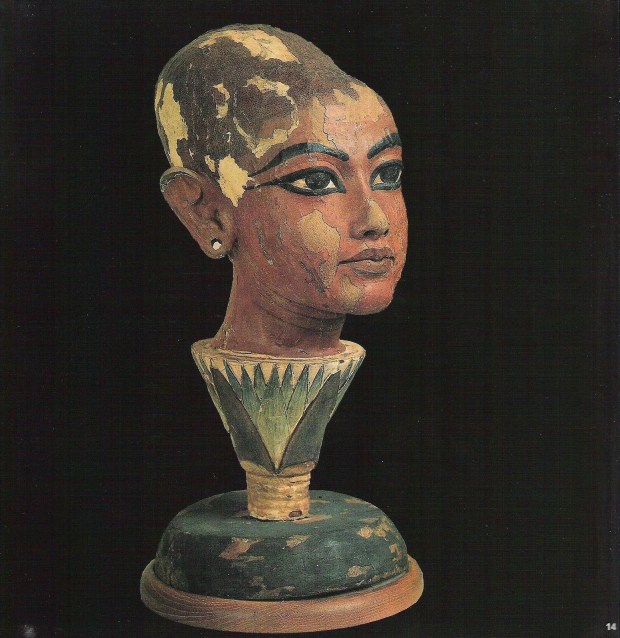
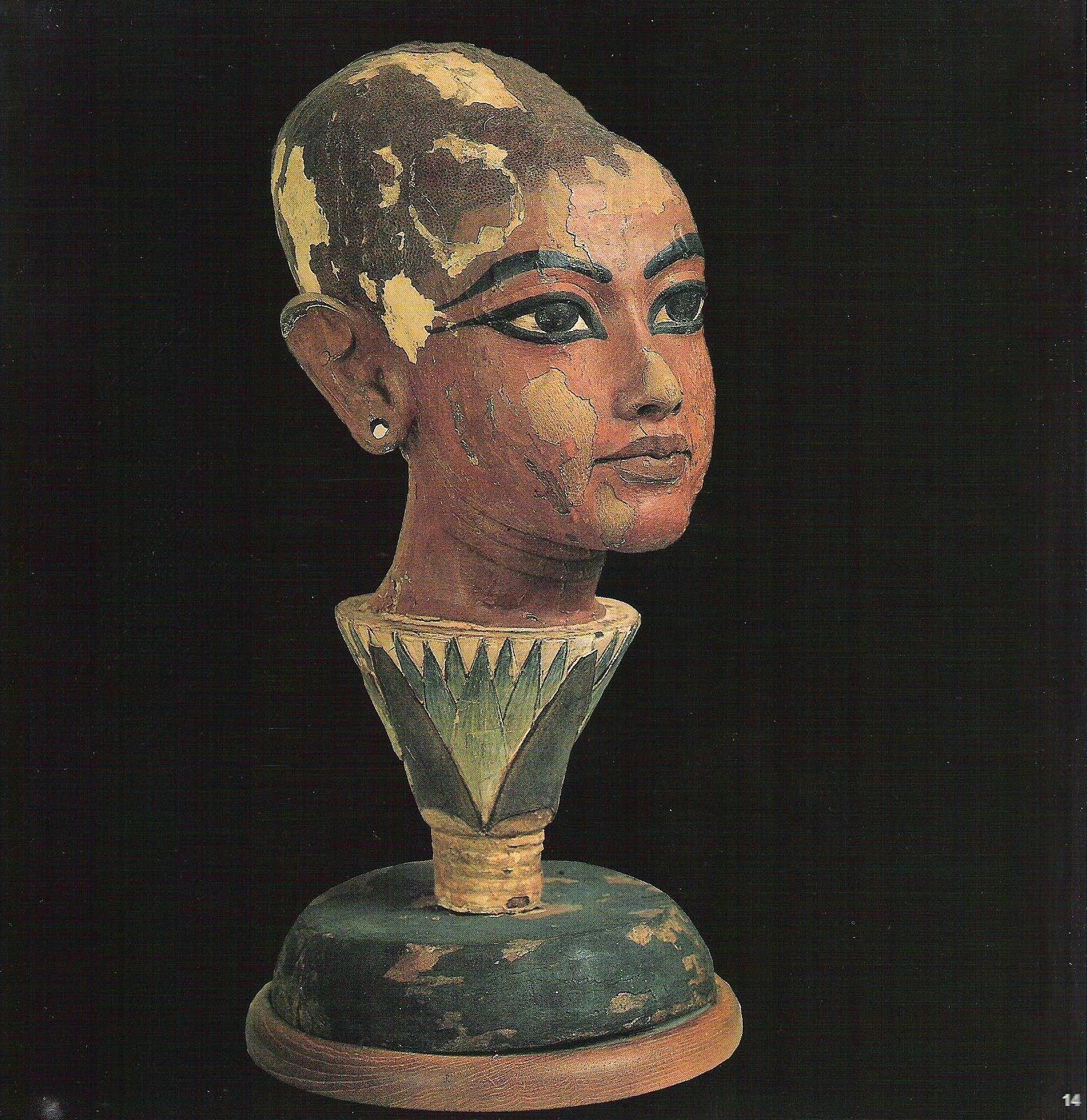
The “unexpected treasures,” as Carter described them, suddenly brought to light an Egyptian king previously almost unknown — Tutankhamun, born approximately 1340 B.C., who ascended the throne as a child. A statue shows the boy king with chubby cheeks and a delicate face. Tutankhamun later married his older sister and conceived two children with her, both born prematurely. The fetuses were found in small but magnificent coffins.
The king died at the age of 18. An ardent racer — six of his chariots were also discovered in the tomb — who often went ostrich hunting in the Eastern Desert with his dog, Tutankhamun may have suffered a chariot accident and died of subsequent blood poisoning.
Keep reading The Legacy of Howard Carter by Matthias Schulz; translated from the German by Ella Ornstein ➔ Spiegel
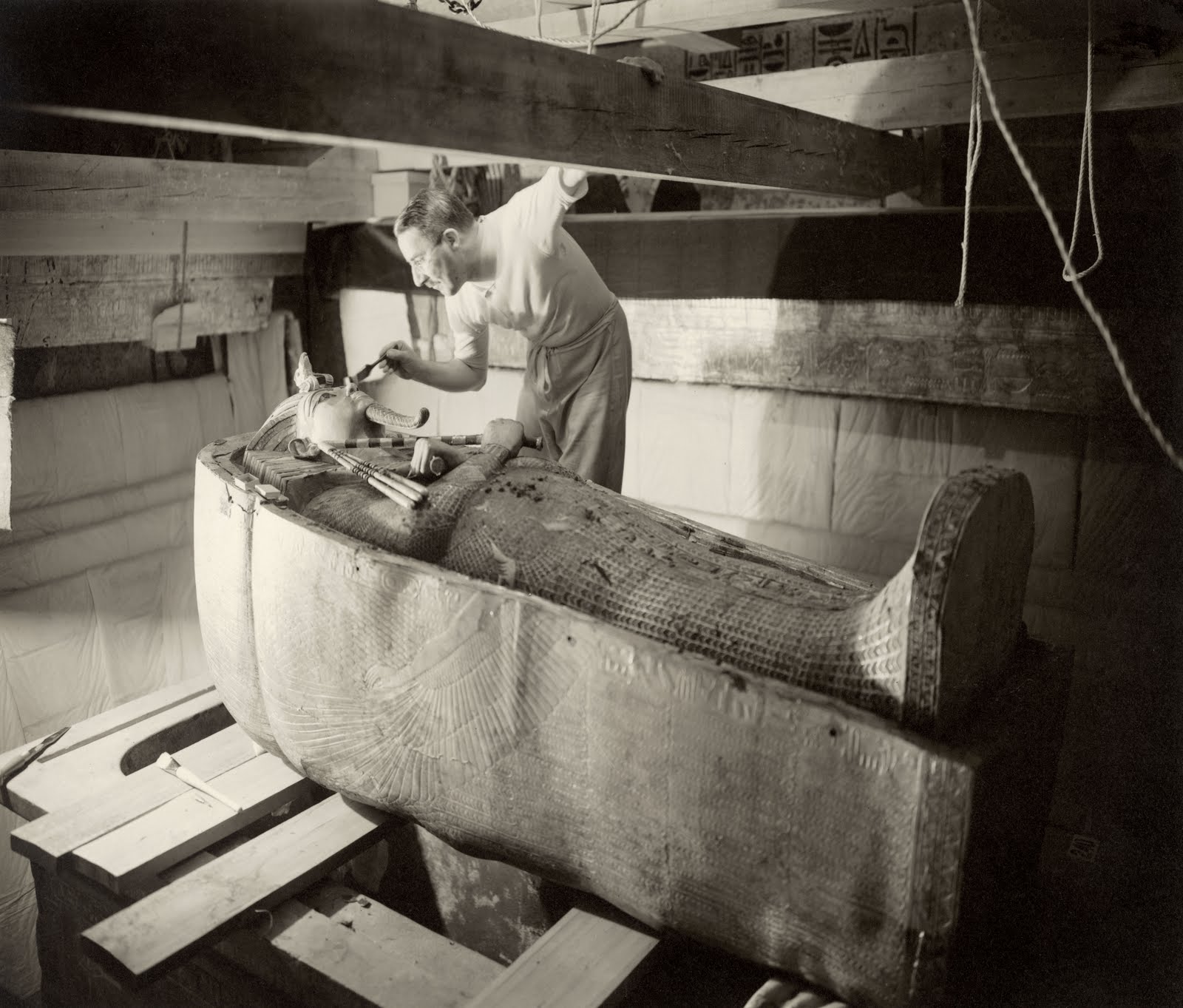
Tutankhamun tomb photographs: a photographic record in 5 albums containing 490 original photographic prints ; representing the excavations of the tomb of Tutankhamun and its contents
➔ Harry Burton
|
|
| Volume 1, [S.l.], [ca. 1922] |
| Volume 2, [S.l.], [ca. 1922] |
| Volume 3, [S.l.], [ca. 1923] |
| Volume 4, [S.l.], [ca. 1923] |
| Volume 5, [S.l.], [ca. 1924] |








 tout ceci est magnifique