Tom and Jerry

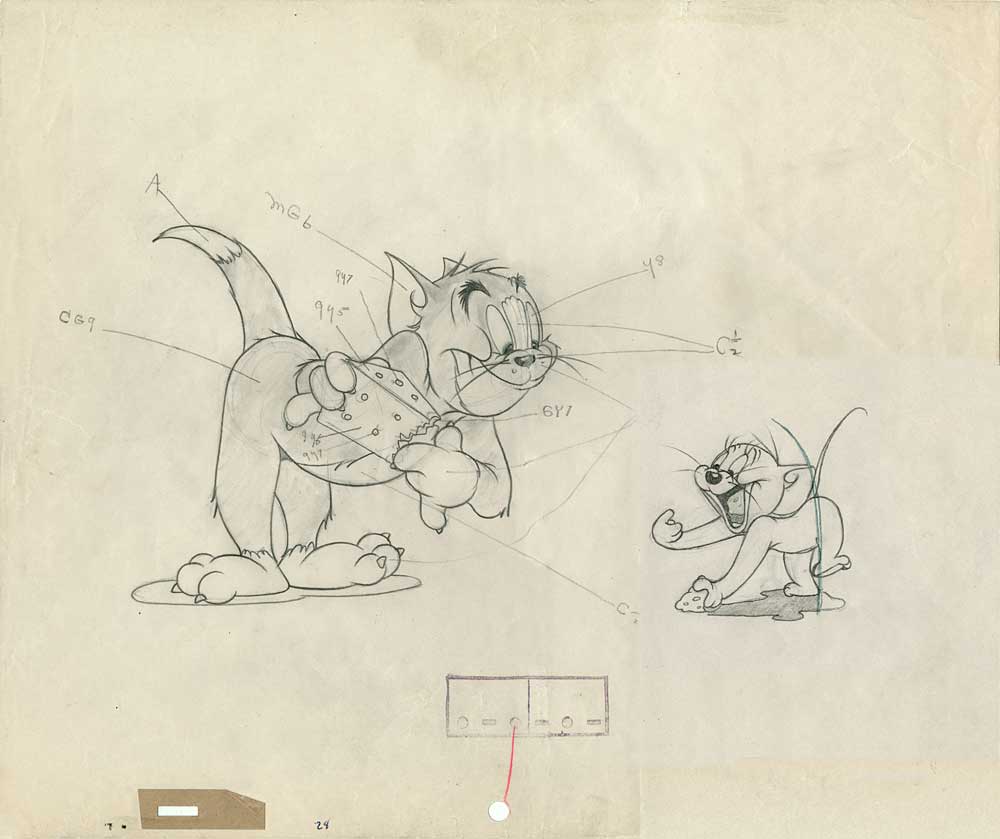
The flagship cartoon from the veteran team of William Hanna and Joseph Barbera, Tom and Jerry featured an ever-dueling cat and mouse who never spoke. They first appeared in the 1940, theatrical short “Puss Gets The Boot” (in which Tom was called Jasper), and were an instant hit with audiences. Although initially intended as a one-shot cartoon, the pressure from distributors for more cat-and-mouse stories resulted in the development of the Tom and Jerry series. 

The two had a familiar relationship – Tom chased Jerry and usually ended up being outsmarted by the plucky little mouse. A typical afternoon for the feuding pair: Tom, a gray cat with a devilish, Machiavellian glint in his eyes, and Jerry, a small, brown, cherubic yet cheeky mouse, chased each other around a kitchen, demolishing the ice box, ironing board, plate rail, a whole sink full of dishes and littering the floor with egg shells, dripping yolks and oozing jam. The kitchen battle waged on, its final outcome unknown to the participants. But to the people watching in the darkness of the theater, there was little doubt as to the identity of the victor – it would be the little mouse. 

In 1965, the Tom and Jerry theatrical shorts came to television, packaged with episodes of Tex Avery’s Barney Bear and Droopy. Even though their long-running theatrical career came to an end two years later, when MGM Studios closed their animation department for good, the feuding duo would not be resigned to cartoon limbo forever. In 1975, ABC tried another version, The Tom and Jerry/Grape Ape Show (this time created by Hanna-Barbera Studios). In 1980 they appeared along with new versions of their old friends Droopy, Barney the Bear and Spike and Slick, in The Tom and Jerry Comedy Show (with animation by Filmation), and appeared again several years later as younger versions of themselves in 1990’s Tom and Jerry Kids.   The Cartoon Scrapbook


ASIFA-Hollywood Animation Archive

florigraphy

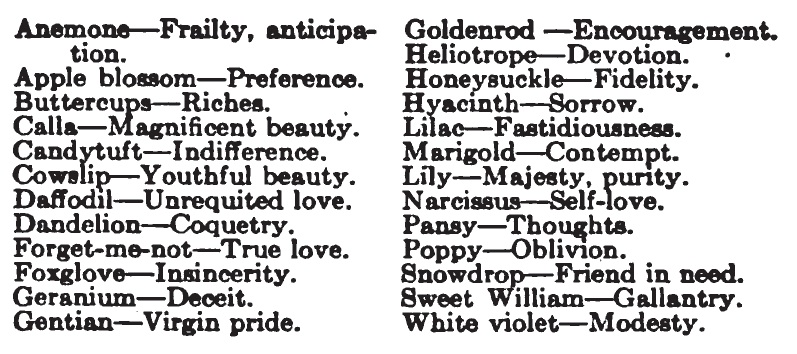
FLOWERS, Language Of, or Florigraphy. The language of flowers is supposed to have been used among the earliest nations; but the Greeks are the first users of whom we have any trustworthy records. They carried it to a very high degree, using flowers as types of everything interesting, public as well as private. The Romans also had a well-developed flower language, and its study was revived during the Middle Ages, when chivalry became preeminent; and it received great development at the hands of the Roman church. Flowers have had an important part in all mythologies. Oak was the patriot’s crown, bay the poet’s, and the myrtle the crown for beauty. The olive was the token of peace, as the ivy was the emblem of Bacchus. The significance of many flowers is derived from their properties. The amaranth has been selected to typify immortality because of its duration. The rose, by universal suffrage made the queen of the flowers, has a symbolism varying with its color: a single red rose signifies “I love you”; the small white bridal rose typifies happy love; and the moss-rose bud a confession of love.  The following are some wellknown flowers, with their symbolism as used in poetry:
New international encyclopedia, Volume 8

Alma Gluck

listen toAve Maria

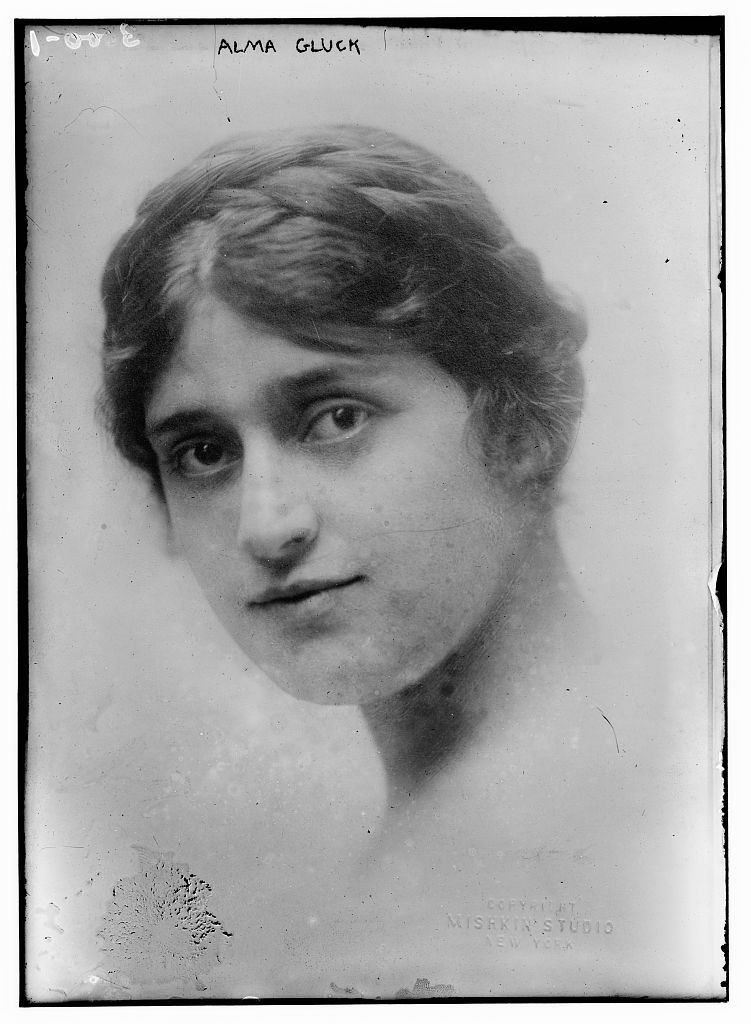
Alma Gluck, the soprano whose recording of “Carry Me Back to Ol’ Virginny” sold almost two million copies, was born Reba Fiersohn on May 11, 1884, in Romania (variously reported as either Iasi or Bucharest). From an impoverished childhood, she rose to become not only one of the finest concert artists of the twentieth century but also one of the most popular. 

Alma was the youngest of seven children, born when her mother (whose name is reported as Anna, Zara, and Edith Sarah) was nearly fifty. Of the six other children, three girls survived infancy. The eldest, Cecile (eighteen years older than Alma), ran the household and reared the others. Her father (reported as Israel, Leon, and Louis Saul), who died when Alma was two, was an opera buff: His older daughters told stories of his attending a performance after hauling produce all day and returning home to sing the entire score for his family. 

By 1890, Cecile Fiersohn, who had paid her own passage to the United States, had saved enough from her sweatshop earnings to send for her mother and sisters. Alma attended public school through eighth grade on New York’s Lower East Side and subsequently worked as an office clerk. Although some accounts indicate that she attended the Normal School (later Hunter College) and Union College, an inspection of school records appears to show that this was not the case. On May 25, 1902, she married Bernard Gluck, an insurance agent (some sources record his name as Glick). They divorced in 1912. Their daughter, Abigail, became the writer Marcia Davenport. 

Although she had a beautiful voice as a girl and learned to play piano, Gluck began vocal training only as an adult. In 1906, a business associate of her husband’s who had heard her sing arranged for her to take voice lessons. She also studied in Europe accompanied only by her daughter. An anecdote tells of Gluck’s serendipitous encounter with Arturo Toscanini. The conductor heard her sing when she arrived for a lesson at her teacher’s house while he and the manager of New York’s Metropolitan Opera were dining there. Both men were skeptical of the teacher’s motives—Gluck was a beautiful woman—until they heard the soprano warming up. Toscanini then insisted on accompanying her himself. (Marcia Davenport writes that the meeting was no accident: Gluck’s teacher engineered it, and Gluck was aware of her listener’s identity.) After a formal audition, Gluck was hired. Toscanini conducted the performance in which she made her debut (under the name Alma Gluck), Massenet’s Werther. It was presented by the Metropolitan Opera but took place at the New Theatre on November 16, 1909. During Gluck’s first season with the company, she sang eleven minor roles in three languages. 

Gluck, however, was not fond of opera’s theatrical nature. Less than a year after her operatic debut, she sang her first recital. By 1911, she had found her niche as a concert artist, a venue in which her charm and elegance were more readily apparent. After leaving the Metropolitan in 1913, she studied in Berlin and Paris. By the following year, Gluck was the most popular concert singer in the United States. She performed in all forty-eight states (traveling later in a private railway car) as a recitalist and orchestral soloist. Until 1921, she gave almost 100 recitals a season, and she continued to perform until 1925. Between 1911 and 1919, Gluck made 124 recordings. Although many were classical, she was famous for her renditions of American folk songs. She was a best-selling artist: Between 1914 and 1918 alone her recording royalties totaled $600,000. 

On June 15, 1914, Gluck was married in London to violinist Efrem Zimbalist. They had two children, Maria Virginia Goelet (b. 1915), and Efrem, Jr. (b. 1918), the actor, writer, and director. Husband and wife often appeared together in concert, and several of Gluck’s recordings feature Zimbalist’s violin obbligatos. In her retirement, Gluck devoted herself to her family and to the artistic world: She was a founder of the American Guild of Musical Artists and was famous for her support of musical causes as well as for her soirées. In 1930, Alma Gluck was diagnosed with an incurable liver ailment. She died in New York on October 27, 1938. 

If Gluck identified herself with the Jewish community as an adult, there appears to be no record of it, and she developed strong ties to the Episcopal church. She left bequests to Union Chapel on Fishers Island, New York, where she had a summer home, and to St. Thomas Church in New York City. In addition, all three of her children were baptized: Maria Virginia and Efrem, Jr. at St. Thomas (in 1921), and Marcia Davenport (in 1922) at the boarding school run by Episcopal nuns to which she had been sent, with her mother as one of her sponsors. Gluck herself, Davenport writes, “drifted on the agnostic sea-of-consent where so many barks float or founder or merely keep on circling, but she did not think that right for her children.”

Paula Eisenstein Baker
Jewish Women’s Archive

[image credit: George Grantham Bain Collection, Library of Congress]

Collected Works of Alma Gluck with Efrem Zimbalist

The Clown

Cloony The Clown by Shel Silverstein
I’ll tell you the story of Cloony the Clown
Who worked in a circus that came through town.
His shoes were too big and his hat was too small,
But he just wasn’t, just wasn’t funny at all.
He had a trombone to play loud silly tunes,
He had a green dog and a thousand balloons.
He was floppy and sloppy and skinny and tall,
But he just wasn’t, just wasn’t funny at all.
And every time he did a trick,
Everyone felt a little sick.
And every time he told a joke,
Folks sighed as if their hearts were broke.
And every time he lost a shoe,
Everyone looked awfully blue.
And every time he stood on his head,
Everyone screamed, “Go back to bed!”
And every time he made a leap,
Everybody fell asleep.
And every time he ate his tie,
Everyone began to cry.
And Cloony could not make any money
Simply because he was not funny.
One day he said, “I’ll tell this town
How it feels to be an unfunny clown.”
And he told them all why he looked so sad,
And he told them all why he felt so bad.
He told of Pain and Rain and Cold,
He told of Darkness in his soul,
And after he finished his tale of woe,
Did everyone cry? Oh no, no, no,
They laughed until they shook the trees
With “Hah-Hah-Hahs” and “Hee-Hee-Hees.”
They laughed with howls and yowls and shrieks,
They laughed all day, they laughed all week,
They laughed until they had a fit,
They laughed until their jackets split.
The laughter spread for miles around
To every city, every town,
Over mountains, ‘cross the sea,
From Saint Tropez to Mun San Nee.
And soon the whole world rang with laughter,
Lasting till forever after,
While Cloony stood in the circus tent,
With his head drooped low and his shoulders bent.
And he said,”THAT IS NOT WHAT I MEANT –
I’M FUNNY JUST BY ACCIDENT.”
And while the world laughed outside.
Cloony the Clown sat down and cried.

Jules Cheret

Panneau décoratif, Exposition Universelle, 1900
Musée des Arts décoratifs, Paris 
[photo Jean Tholance]

Jules Chéret est né à Paris le 31 mai 1836 dans une famille d’artisans. Son père est ouvrier typographe. A 13 ans, il devient apprenti lithographe, mais il s’intéresse déjà à la peinture en se rendant régulièrement au Musée du Louvre, pour y admirer Rubens Fragonard ou Watteau. Il devient peu après son apprentissage, ouvrier lithographe chez un imprimeur d’images pieuses et s’inscrit aux cours de l’Ecole Nationale de Dessin. Il trouve ensuite une place de dessinateur à Dôle et commence à créer des vignettes lithographiques pour la réalisation de brochures ou de couvertures de livres.

Il quitte la France pour l’Angleterre en 1856, pour apprendre de nouveaux procédés sur les techniques de la lithographie en couleurs. De retour à Paris en 1866, il créé son imprimerie pour réaliser des affiches illustrées en couleurs. Le succés est rapide : Jules Chéret multiplie ses créations d’affiches de réclames publicitaires qui lui assurent sa notoriété. En 1881, il cède son affaire et devient Directeur artistique de l’Imprimerie Chaix, ce qui lui permet de se consacrer davantage à son oeuvre artistique : affiches, dessins, gouaches. En 1889, il réalise sa première exposition et reçoit une médaille d’or à l’Exposition Universelle.

Jules Chéret n’aime guère l’esprit des salons et des expositions. Il préfère proposer ses oeuvres directement par relations à des amateurs éclairés, tels que le Baron Vitta, ce qui explique pourquoi son oeuvre de peintre reste encore mal connue, occultée qu’elle est par son travail d’affichiste des années antérieures.

Fauteuil du salon Rehns
Musée des Arts décoratifs, Paris 

A partir de 1895, Jules Chéret s’essaie dans une voie nouvelle qui est celle de la peinture de fresques murales, grâce à la commande de son admirateur le Baron Vitta pour la décoration de sa Villa ” La Sapinière ” à Evian.

En 1898, Jules Chéret décide de s’installer à Nice avec son épouse. Au cours de l’annéee 1900, il reçoit  une commande pour la réalisation d’un rideau de scène au Musée Grévin, qui restera l’un de ses chefs d’oeuvres dans ce domaine. Il reçoit également une commande pour la décoration d’un salon de l’Hôtel de Ville de Paris, qu’il achève en 1902.

En 1905, il participe à la décoration de la Taverne de Paris et en 1906-1907, il décore la salle des fêtes de la Préfecture de Nice sur le thème du carnaval et de la fête.

A côté de ses activités professionnelles de décorateur et à sa production de dessins et d’études préparatoires, Jules Chéret réalise de nombreux pastels et des peintures dont le sujet d’inspiration principal sera la femme dans sa beauté, sa grâce, sa coquetterie vestimentaire. Il peint également de nombreuses oeuvres sur le thème de la Commedia dell’Arte, la fête, et des scènes champêtres.

Dans les années 1920, atteint de cécité, il doit abandonner la peinture, et vient résider le plus souvent à Nice. Le Baron Vitta lègue à la ville de Nice une grande partie de sa collection d’oeuvres de Chéret, ce qui permet d’y ouvrir le Musée des Beaux Arts Jules Chéret. L’inauguration se tient en janvier 1928 en présence de l’artiste, et c’est le peintre symboliste Gustav-Adolf Mossa qui est est nommé le premier conservateur. 

Portrait du Baron Vitta, 1908
Musée des Beaux-Arts Jules Chéret, Nice 
[photo Muriel Anssens]

Quatre ans plus tard, le 23 septembre 1932, Jules Chéret décède à l’âge de 86 ans, pour être inhumé selon ses voeux au cimetière St Vincent de Montmartre à Paris.
Jules Chéret fut tout d’abord un pionnier dans le domaine de l’affiche lithographique en couleurs, et il est considéré comme l’inventeur de l’affiche moderne publicitaire. La lithographie a été l’une de ses techniques préférées. A côté de ses fameuses affiches, il a réalisé dans des formats plus modestes un grand nombre d’oeuvres lithographiées, proches des dessins, destinés à illustrer par exemple des menus, des programmes de spectacles, des faire-parts de naissance, et nombre de travaux intimistes.

Jules Chéret fut également un grand décorateur mural. Cette oeuvre décorative est visible à la Villa “La Sapinière” (1895-1897) de son ami le Baron Vitta, mais aussi à l’Hôtel de ville de Paris (1898-1902), au Musée Grévin, avec le rideau de scène (1900), à la Taverne de Paris (1905), à encore à la Préfecture de Nice, entre autres …

Napoléon + Brando

Marlon Brando ~ Désirée (1954)
Paul Hippolyte Delaroche ~ Napoléon à Fontainebleau, 1840 [Musée de l’Armée, Paris]

Often described as showing Napoleon at Fontainebleau after his first abdication, this icon of the imperial legend in fact shows the emperor several days before he performed that political act, indeed at the very moment where he realised that the wheel of fortune had turned.

Some of the preparatory material for the painting exists, although unpublished and in private hands. The leaf in question, in Delaroche’s hand, bears a transcription reworked of a passage from the Memoirs of Bourienne, Napoléon secretary.* The passage relating to the end of the French Campaign sheds light on the birth of the painting: ‘after having spent a part of the night at Froidmanteau “he repaired to Fontainebleau, where he arrived at six in the morning. He did not order the great apartments of the castle to be opened, but went up to his favourite little apartment, where he shut himself up, and remained alone during the whole of the 31st of March”, 1814.

Just off his horse, his great coat and boots still spotted with mud, and his hat thrown on the ground, his papers case thrown on the divan, the emperor sits slumped in a chair, aghast at recent events.
Defeated, and already abandoned by many of his erstwhile supporters, here he is alone in his private apartments in Fontainebleau, staring destiny in the face. He sees glory turns its back on him and understands that his fall is close.

Delaroche seems to have taken his inspiration for the pose from two contemporary engravings, one, a lithograph Burdet, after Raffet, Napoléon 1812, illustrated in Anquetil and Burette’s l’Histoire de France (Paris, 1838), and the other, a vignette on wood by Loutrel, after Horace Vernet, Première abdication de Napoléon Ier à Fontainebleau, illustrated in Laurent de l’Ardèche’s l’Histoire de l’Empereur Napoléon (Paris, 1839).

Seen in the light of Bourrienne’s text and after close observation of the painting, the subject seems to have much more dramatic tension than is usually believed.
The choice of such a key, transitional moment of introspection is typical of Delaroche, who himself was a history painter of unsettled nature and who was to suffer increasingly from depression. Indeed, he was fascinated by Napoleon and painted the first consul and then emperor several times at different moments in his career, in works which seem to follow the destiny of the Consulate and the Empire, from rise, to fall, to the birth of the legend.

Several versions of the painting are known, but that most frequently reproduced is the work belonging to the Leipzig Museum der Bildenden Künste, dated 1845, and often incorrectly identified as the original of this celebrated composition. That here, dated 1840, could have been painted on the occasion of the return of Napoleon’s body, just like Horace Vernet’s, Napoleon rising from his tomb, widely reproduced in engraving form. However, unlike Vernet’s glorious image, done in small format, that by Delaroche shows the emperor as an anti-hero, in a banal pose but transposed into the large format, traditionally the domain of history painting in the grand style. 

Frédéric Lacaille.
tr. P.H.

* Only the words within “” are by Bourienne. The rest is by Delaroche. P.H.

Napoleon.org